
The Default Mode Mind
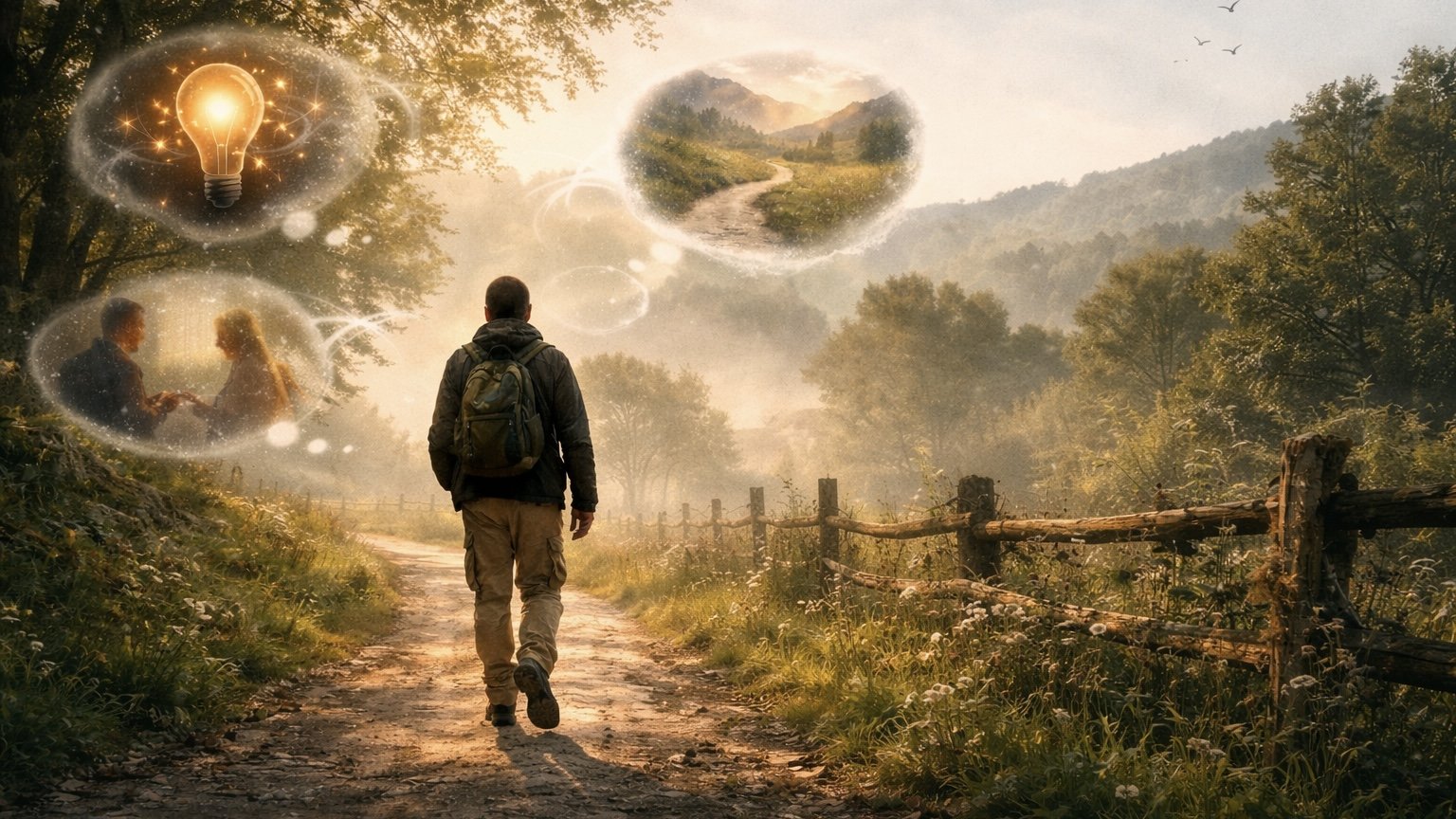
Why long walks unlock a deeper, more human form of intelligence
There is a moment that arrives to me reliably, but never on command.
It happens when a solo walk stretches beyond usefulness. Beyond fitness. Beyond destination. Somewhere after sixty minutes, sometimes a little later, the mind quietly changes gear. Not dramatically. No fireworks. Just a subtle loosening, a sense that thinking is no longer being pushed but gently pulled. Effort gives way to drift. Control gives way to flow.
This is the state I have come to recognise as my Default Mode Mind.
At first glance it feels ordinary. You are still walking. Still breathing. Still noticing trees, paths, weather. Yet something important has shifted. Thoughts stop lining up like items on a to do list and start behaving more like a murmuration. Memories surface without invitation. Ideas connect that were never consciously introduced. Questions rephrase themselves. Solutions arrive sideways.
What feels like daydreaming turns out to be something far more serious.
The brain’s default setting
For most of the twentieth century, neuroscience assumed that the brain only really “worked” when it was busy with a task. Concentrating, calculating, reacting. When nothing obvious was happening, the brain was assumed to be idling, like a car engine waiting at a red light.
That assumption turned out to be wrong.
When researchers began imaging the brain at rest, they discovered something unexpected. Large, well organised regions of the brain were not quiet at all. They were highly active when people were doing “nothing”, and they became quieter the moment attention turned outward to a specific task.
This network came to be called the Default Mode Network. It is the brain’s baseline state. Its background hum. Its intrinsic activity. In everyday language, it is what turns on when we are not being told what to think about.
The Default Mode Network supports our inner narrative. It is where we think about ourselves, replay past events, imagine future scenarios, and stitch experiences into something resembling a coherent life story. It allows us to travel mentally through time, to simulate possibilities, to reflect on meaning rather than merely react to stimuli.
This is not a flaw in the system. It is the system.
When the mind turns inward
When the Default Mode is active, attention shifts away from the outside world and toward the inside one. Memory, imagination, identity, and emotion begin to talk to each other. Past conversations resurface. Future conversations are rehearsed. Loose ends are revisited. Old ideas quietly bump into new ones.
This is why the state is so familiar. We enter it in the shower. On trains. While washing dishes. And, most reliably, during long walks.
But familiarity has bred misunderstanding. The Default Mode has a bad reputation. It is often blamed for rumination, anxiety, and getting stuck in one’s head. And rightly so. When poorly regulated, this same system can loop endlessly through regret or worry, replaying the past or catastrophising the future.
The crucial point is this: the Default Mode is not inherently good or bad. It is powerful. And power, without the right conditions, can turn against us. The difference between destructive rumination and creative insight lies not in the network itself, but in how it is modulated.
Walking as a regulator, not a trigger
This is where walking enters the picture. Walking does not magically make us creative. It does something subtler and more interesting. It changes the balance of power inside the brain.
Moderate, rhythmic movement shifts resources away from the brain’s executive control centres, particularly those involved in planning, inhibition, and self criticism. This temporary down regulation is known as transient hypofrontality. In simple terms, the inner manager takes a short break.
This matters because the executive brain is very good at saying no. No to half baked ideas. No to unlikely connections. No to anything that might be socially awkward, inefficient, or wrong.
When its grip loosens, something else is allowed to speak. The Default Mode does not need permission. It needs space.
Walking provides that space in a uniquely effective way. It is repetitive enough to calm the nervous system, yet engaging enough to prevent agitation. It occupies the body just enough to free the mind. Cognition evolved on the move, not in chairs. Our brains learned to think while legs were already doing something else.
Importantly, this effect depends on intensity. Sprinting shuts the mind down. High effort exercise demands so much metabolic attention that thinking narrows to survival. Walking sits in a sweet spot. Enough movement to quiet the critic. Not enough to silence thought altogether.
Why time matters
Many people notice that something shifts only after a certain duration. Thirty minutes feels good. Forty minutes feels clearer. Somewhere around an hour, the walk deepens.
This is not imagination. Different processes unfold on different timelines. Blood flow and alertness improve quickly. The loosening of executive control happens relatively early. But the deeper emotional and creative shift takes longer.
Sustained walking triggers the release of endocannabinoids, natural molecules that cross into the brain and reduce anxiety, soften emotional reactivity, and promote a sense of calm focus. This is not a rush. It is a settling. A quieting of internal noise.
Longer durations also support the release of growth factors associated with brain health and plasticity. Over time, this kind of movement does not just change how we feel during the walk. It changes how resilient and flexible the brain becomes.
The sixty minute mark is not a magic switch. It is a threshold where several beneficial processes begin to overlap.
Generative Human Intelligence
In this state, thinking changes character. Instead of executing tasks, the mind generates possibilities. Instead of optimising, it explores. Instead of narrowing, it opens.
This is why I find it useful to think of this mode as Generative Human Intelligence.
Generative HI is slow. Embodied. Context rich. It draws on lived experience rather than abstract data. It tolerates ambiguity and allows bad ideas to exist long enough for good ones to emerge. Meaning is assembled rather than retrieved.
This is fundamentally different from generative artificial intelligence. AI generates by predicting what is most likely to come next based on enormous amounts of existing material. It is fast, precise, and obedient. It has no body. No memory of being embarrassed. No sense of effort or fatigue or hope.
Generative HI, by contrast, is grounded in a lifetime of sensations, emotions, social interactions, and failures. It simulates futures not by probability, but by felt relevance. It does not produce outputs on demand. Often it produces feelings before thoughts, and thoughts before words.
It cannot be rushed. It cannot be commanded. It requires time, safety, and movement.
Boredom as the bedrock of creativity
One of the quiet heroes of this process is boredom. Not the restless boredom of waiting in line while scrolling a phone, but the gentle boredom of unclaimed time. Time with no demand attached. No notifications. No content pipeline.
Modern life treats boredom as a problem to be solved. In reality, boredom is a signal. It tells the mind that the environment is no longer feeding it. When external input drops, internal generation begins.
This is the incubation phase of creativity. The mind wanders. Connections form below the level of conscious control. Ideas are tested without being judged.
Walking protects boredom without tipping into discomfort. It gives the body something to do while leaving the mind free to drift.
Talking to yourself is not madness
In this state, another curious thing often happens. We start talking to ourselves. Not muttering. Explaining.
We test ideas out loud. We rehearse arguments. We clarify concepts as if an invisible listener were present. This is not noise. It is structure.
Speaking forces thought into sequence. It turns overlapping impressions into language. It gives shape to what would otherwise remain vague. Psychologists call this private speech, and it is a powerful tool for organising thought and regulating emotion.
Talking is not the opposite of thinking here. It is how thinking completes itself. Walking loosens associations. Talking tightens them just enough to be useful.
The Camino as a cognitive environment
This is why the prospect of long distance walking feels so quietly exhilarating. Not just for the scenery. Not just for the physical challenge. But for the mental ecology it creates.
Hours of rhythmic movement. Extended boredom. Minimal interruption. Day after day of the same gentle conditions that invite the Default Mode into its healthiest, most generative form.
Generative HI not as a rare accident, but as a daily companion. Ideas not forced into existence, but invited. Thinking not squeezed between obligations, but allowed to unfold at walking speed.
In a world obsessed with acceleration, this is almost subversive. Yet it may be one of the most human things we can still do.
Walk long enough, and the mind does not empty. It remembers how to think for itself.
