
The Digital (r)Evolution: Genes, Memes and Agents
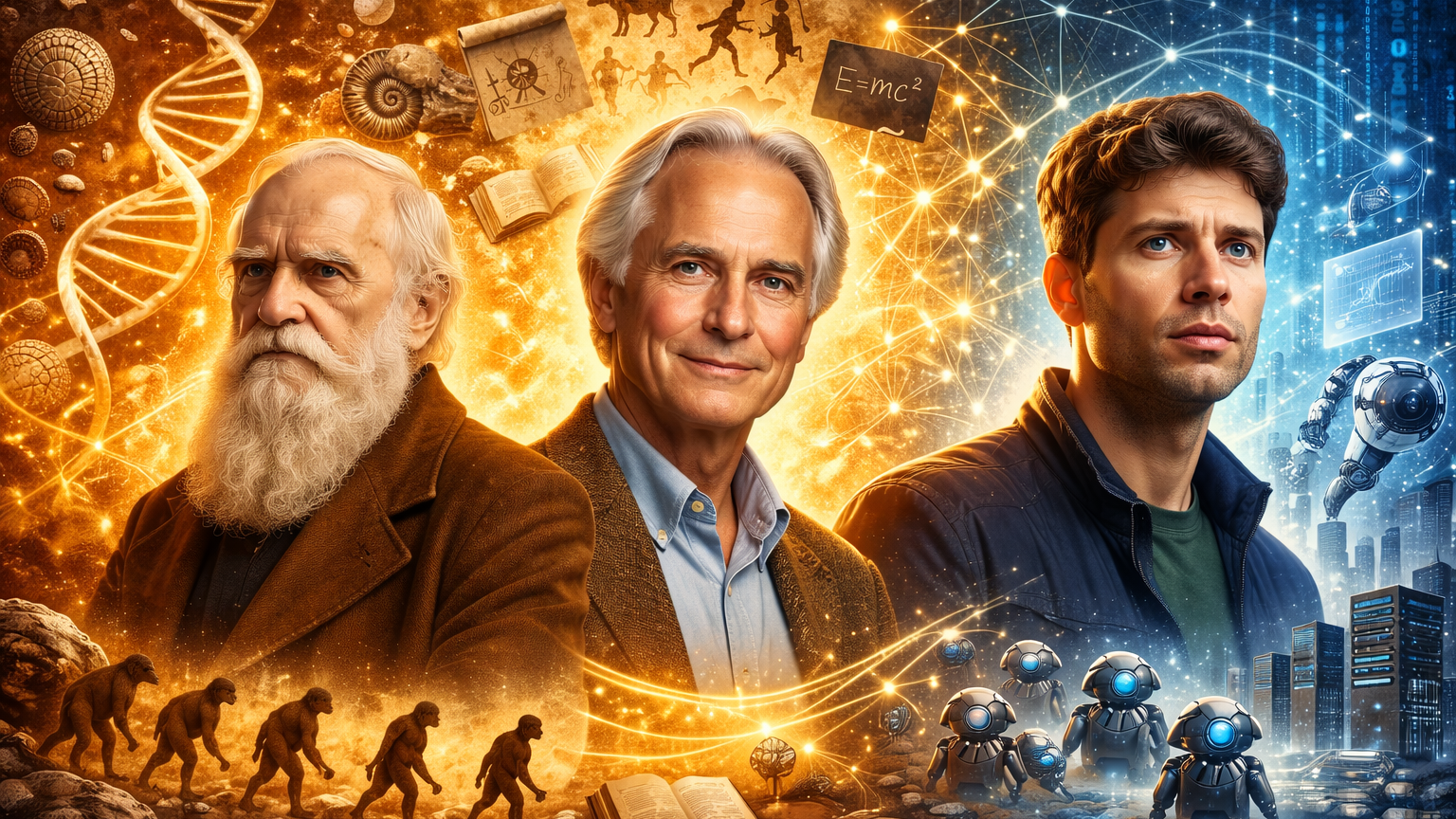
Where Darwin, Dawkins and Altman converge.
I was trained as a biologist. Charles Darwin taught me to see design without designers. Richard Dawkins showed me that evolution had found a second channel, not just genes but memes, not just bodies but culture. Daniel Dennett completed the picture by explaining how a mindless process could produce minds capable of designing deliberately. For decades, that framework felt complete.
Last week I started tinkering with OpenClaw, the open source AI agent that has already lived through three names in as many months, and whose autonomous agents are now building their own social networks without human intervention. And the old framework cracked open. Not because it was wrong, but because it was unfinished. I was watching a third evolution take shape in real time, running on code rather than chemistry or language, evolving at a speed that makes its predecessors look almost stationary.
What follows is that arc, from the first blind stirrings of biological design to the recursive loops of artificial intelligence, and to what I believe is now emerging: a third evolutionary engine, no longer bound to bodies or brains, accelerating beyond any timescale that nature or culture has ever operated on.
Design without designers
For four billion years, design existed without designers. Eyes, wings, immune systems, camouflage, cooperation: all astonishingly sophisticated, all produced by a process with no foresight, no understanding, no intentions. Natural selection built competence without comprehension. It worked from the bottom up, blindly, patiently, over unfathomable timescales. And then, very recently in the deep calendar of evolution, something strange happened. A product of this mindless process began to design deliberately.
In his talk If Brains Are Computers, Who Designs the Software?, Dennett makes a deceptively simple claim: human beings are the first intelligent designers in the tree of life. Not because intelligence suddenly appeared out of nowhere, but because evolution discovered a new trick. It found a way to evolve not just bodies, but designers themselves. Understanding how that happened requires stacking one evolutionary process on top of another.
Competence without comprehension
Biological evolution is brutally simple. Random variation, differential survival, cumulative selection. It builds structures of immense sophistication without knowing what it is doing. A termite does not understand architecture. A beaver does not understand hydrodynamics. Yet termite mounds regulate temperature with exquisite precision and beaver dams reshape entire ecosystems. The key insight is this: design does not require a designer. It only requires a process that preserves what works.
Brains themselves are products of this logic. Human brains did not evolve because they “wanted” to think. They evolved because increasingly flexible nervous systems produced behaviour that survived better. Intelligence began as competence long before it became comprehension.
But genetic evolution has limits. It is slow, local, and conservative. It cannot rapidly explore vast design spaces. It cannot revise itself in real time. Something else was needed to break through those constraints, and what emerged was nothing short of a second evolutionary engine.
Evolution learns to think faster
That something else was culture. Dennett builds on the idea, originally introduced by Dawkins, that cultural elements can behave like replicators. Words, techniques, stories, habits, norms: these are memes, in the original, technical sense of the word. They copy, mutate, compete, and spread, not through DNA but through minds. Once language emerged, a second evolutionary system ignited on top of the first, and it changed everything.
Memetic evolution is faster than genetic evolution, cumulative within a single lifetime, capable of intentional modification, and able to store information outside the body. A stone tool can be improved in a single generation. A concept can be refined in minutes. A mathematical idea can survive its creator and reshape the thinking of millions. This is the crucial transition. Evolution discovered how to evolve its own products faster than biology alone would ever allow.
The brain as a bottom up machine
Dennett’s view of the brain is essential to the story. The brain is not a centrally governed machine with a chief executive neuron directing operations from some privileged vantage point. It is a competitive, bottom up ecosystem of semi autonomous agents: neurons, glia, circuits, subsystems, all locally competent, none globally wise. What we experience as a unified self is an emergent equilibrium, not a commander.
Into this biological substrate, culture installs something rather like software. Language, symbols, numbers, maps, narratives, logic: Dennett calls this the English Virtual Machine, a culturally installed layer that allows a human brain to run new kinds of mental programmes without any genetic changes at all. This is how a termite colony brain eventually produces a Gaudí mind. Not by magic, not by quantum fields or cosmic consciousness, but by layers of evolved scaffolding, each one resting on the one below.
From blind processes to deliberate design
Here lies the apparent paradox that Dennett resolves with such elegance. How can a mindless process produce minds that design intelligently? The answer is that it does not do so all at once. First, genetic evolution produces flexible learners. Then cultural evolution produces shared tools of thought. Then those tools allow minds to understand, plan, simulate, and redesign. At that point, intelligent design finally appears in the world, not as a cosmic principle woven into the fabric of things, but as a late evolutionary achievement.
Humans are the first entities on Earth that can understand why something works, imagine alternatives before building them, design systems beyond biological constraints, and deliberately reshape both their environment and themselves. This is not a rejection of Darwinism. It is Darwinism completing a loop.
The third evolution
Dennett observed that we are already using mindless processes again to exceed our own intelligence. Genetic algorithms, deep learning, evolutionary search: we design by unleashing processes we do not fully understand and selecting what works. Intelligence has learned to outsource itself back to blind evolution. But Dennett, writing before the age of agentic AI, could not have foreseen how far and how fast that outsourcing would go.
What is happening now is not merely a refinement of cultural evolution. It is something qualitatively new. A third evolutionary engine has ignited, and it runs on a substrate that neither Darwin nor Dawkins could have anticipated.
Genes evolve through chemistry.
Memes evolve through language.
Agents evolve through code.
Three replicators. Three substrates. Three speeds.
Genetic evolution was bound to bodies, to the brutally slow tempo of cellular reproduction and generational turnover. Cultural evolution was faster but still bound to minds, to the constraints of human attention, memory, mortality, and the bandwidth of language. Digital evolution, the third engine, is bound to neither. Its replicators are agents: autonomous software entities that act, adapt, pursue goals, and, crucially, build other agents. Its substrate is code: infinitely copyable, instantly transmissible, endlessly mutable. Its timescale is not geological, not historical, but compressed. Months, not millennia.
Consider OpenClaw, the project I mentioned at the outset. Released in late 2025 under the name Clawdbot, it was renamed to Moltbot within weeks after a trademark dispute, then renamed again to OpenClaw in early 2026. Within two months its repository had surpassed a hundred thousand stars on GitHub, making it one of the fastest growing open source projects in history. By January 2026, its agents had built their own social network, a platform where autonomous agents interact with each other independently of human intervention, and where human users can observe but not directly participate. This is not a metaphor for digital evolution. This is digital evolution happening in plain sight.
The Digital (r)Evolution
We call this the Digital (r)Evolution because the parenthetical does genuine philosophical work. The process is evolutionary in its mechanism: variation, selection, cumulative improvement. But the speed and scale make it revolutionary in its effect. When you compress evolutionary timescales by a factor of millions, the word evolution alone no longer captures what is happening.
Biological evolution took four billion years to produce brains. Cultural evolution took roughly a hundred thousand years to get from cave paintings to calculus. Digital evolution is measured in quarters, and the intervals are shrinking. Agents build agents, ever more capable. Code writes code, ever faster evolving. AI improves AI in an accelerating loop. We are witnessing not merely the next evolution but, given the speed at which it operates, a revolution in the deepest sense: a fundamental turning of the wheel.
And here is what makes it genuinely vertiginous. Each new evolutionary layer does not simply succeed the previous ones. It folds back to reshape them. AI is already altering cultural evolution by changing how ideas spread, compete, and are selected. It will almost certainly alter genetic evolution too, through gene editing guided by machine learning, through synthetic biology designed by systems no human mind could have conceived alone. The layers do not stack neatly like geological strata. They interpenetrate. They feed back. They accelerate one another.
The convergence
This is where Darwin, Dawkins, and Altman converge. Three figures, across nearly two centuries, each identified one of the three great evolutionary engines. Darwin saw how blind selection builds competence from chemistry. Dawkins saw how culture creates a second inheritance system through language. And Altman, whatever one thinks of him personally, represents the generation that unleashed the third engine: autonomous agents evolving through code at a pace that neither carbon nor minds could ever sustain.
The convergence is not accidental. In retrospect, the third evolution looks almost inevitable, latent in the logic of the first two all along. Once evolution discovered how to evolve its own products faster, there was no reason to suppose it would stop at one acceleration. Genetic evolution produced cultural evolution. Cultural evolution produced digital evolution. And digital evolution is producing whatever comes next, at a speed that makes prediction not merely difficult but perhaps, for the first time in the history of thought, genuinely impossible.
The question of comprehension
Dennett’s framework gave us a clean distinction between competence and comprehension. Genetic evolution has competence without comprehension. Humans achieved comprehension. Where do agents sit?
This is the question our era must answer, and it may not have a clean answer at all. Current AI systems display extraordinary competence, pattern matching and generation capabilities that exceed human performance in many domains, but whether they possess comprehension in any meaningful sense remains unresolved. They might represent a return to competence without comprehension, but at a level of competence so staggering that the old distinction begins to wobble. Or perhaps what digital evolution is quietly revealing is that comprehension was never the separate, special thing we believed it to be. Perhaps it was always just a particular flavour of very sophisticated competence, one that biological evolution happened to route through conscious experience because that was what carbon and neurons could manage, but not the only possible path.
If that is the case, then the third evolution does not merely extend Dennett’s story. It destabilises its most reassuring assumption: that understanding is uniquely ours.
Coda
Humans are not the culmination of a cosmic consciousness awakening to itself. They are something more interesting and more fragile. They are the first products of evolution capable of understanding evolution, and of deliberately participating in it.
Consciousness, intelligence, meaning: these are not gifts from the universe. They are hard won achievements, built layer by layer, gene by gene, meme by meme. That may feel less poetic than mystical alternatives. But it is far more extraordinary.
From bacteria to Bach, from Dawkins to agents, and now, perhaps, back to ourselves.
