
From One to Thirty Seven Trillion
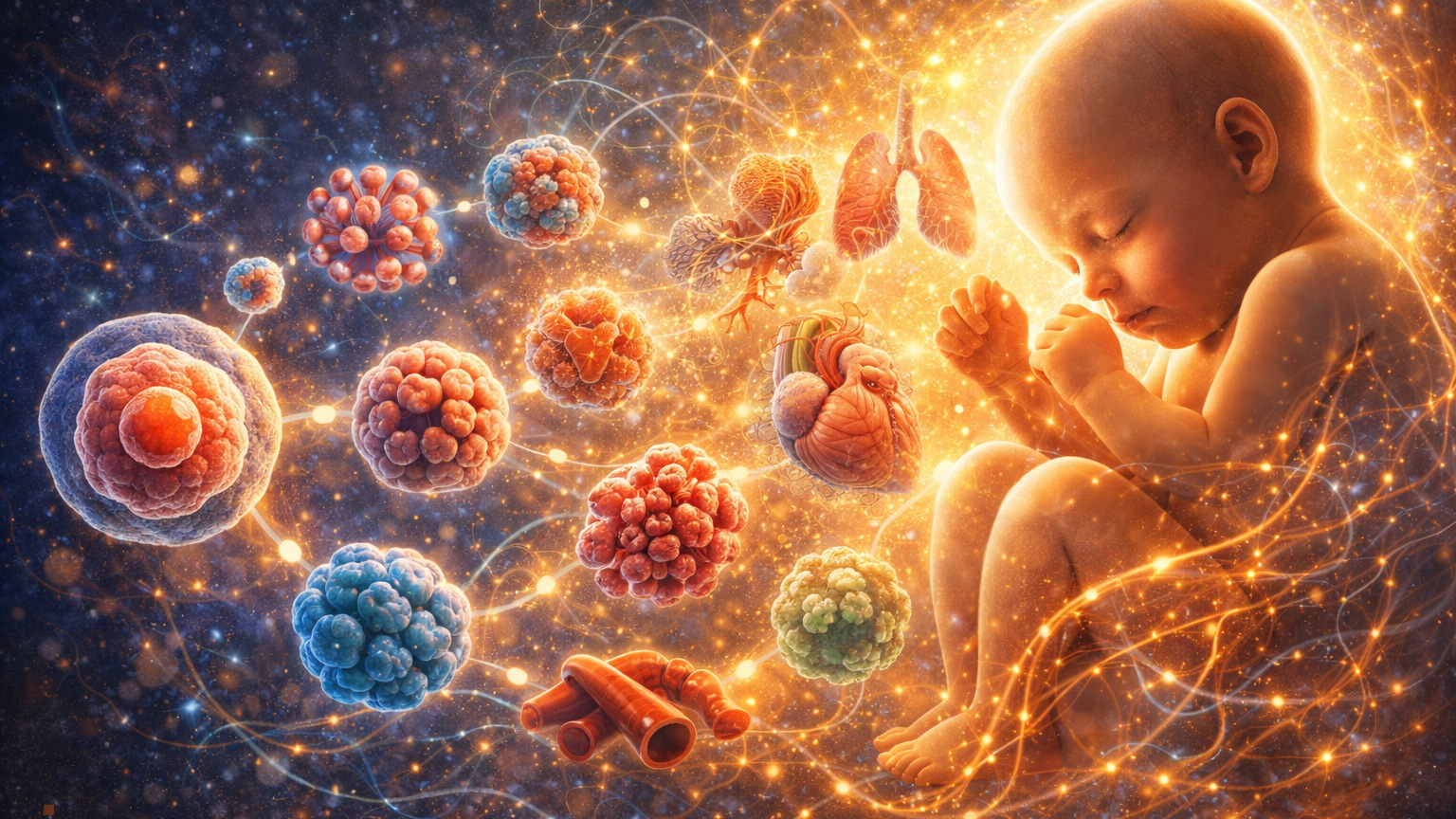
Each living organism, including you, started with an absurd imbalance. One fertilised egg cell possessing no organs, no nerves, no thoughts, and no awareness whatsoever that it is about to become anything at all. Within a few decades, that single cell will have produced roughly thirty seven trillion descendants, organised not as a heap or a swarm but as a precisely coordinated living system, complete with eyes that see, hands that feel, and a brain that wonders how any of this ever worked in the first place. This transformation is so familiar that we rarely stop to notice how genuinely implausible it really is.
How does one cell accomplish this? Not through poetry, not through slogans, but through actual biological steps. Let us walk it through.
The flux of identity
After fertilisation, the cell begins to multiply, dividing into two, then four, then eight, with each generation doubling the count. At this earliest stage, the cells are totipotent, meaning they retain the potential to become any part of the body or even the supporting placenta. This biological state represents maximum optionality, and nothing particularly clever is happening yet. Just copying. The same DNA replicated again and again in a process that is fast, mechanical, and surprisingly forgiving.
Yet a profound philosophical puzzle emerges from these earliest divisions. We tend to think of ourselves as stable things, as objects that persist through time, yet biology reveals that we are better understood as processes. Most of the atoms within your body are replaced every few years through metabolism and cellular turnover. The physical matter composing you is in constant flux even as you remain recognisably yourself.
This is the Ship of Theseus made flesh. If every component is gradually replaced, what exactly persists?
Biology offers a quietly radical answer. You are not the material itself. You are the pattern that the material temporarily inhabits. Carbon and nitrogen atoms come and go like guests at an inn, but the arrangement remains. The pattern persists. The substrate flows through.
The epigenetic landscape
As the growing cluster of cells folds and reshapes itself, location becomes destiny. Some cells find themselves on the surface while others are buried deeper inside. This exposes them to different chemical signals, and these differences matter enormously. Cells do not decide what they will become in isolation. They respond to where they are and to what their neighbours are doing.
This is where epigenetics enters the story, not as something mysterious but as something thoroughly physical. While every cell contains the same DNA sequence, the environment places chemical marks upon that code. Methyl groups attach to specific sites. Histone proteins around which DNA is wrapped are modified. These changes silence some genes while amplifying others, producing radically different outcomes from identical genetic information.
What makes this so important is that it punctures naive genetic determinism without invoking anything mystical in its place. You are not a passive readout of instructions written at conception. Development unfolds as a continuous conversation between genes and environment. Epigenetic marks act as a form of cellular memory, recording context, exposure, and history. The genome provides possibilities. The epigenome selects among them. Both obey ordinary chemistry.
From this process, three broad layers emerge. One gives rise to skin and nervous tissue. Another to muscle and blood. The third to gut and internal organs. Same DNA. Different contexts. Different futures. Genes are not commands issued from above but possibilities waiting to be selected.
The great narrowing
As development continues, cells begin to specialise in earnest. A cell that could once have become almost anything now closes doors behind it, committing to a particular path. Muscle cells invest heavily in the machinery of contraction. Nerve cells invest in signalling. Liver cells transform themselves into metabolic factories.
Nothing external forces these decisions. They emerge from gene networks turning each other on and off in response to local signals. Once a particular pathway gains momentum, it stabilises itself through feedback loops that make reversal increasingly difficult. This is why turning a skin cell into a neuron is so hard. Not because the necessary DNA is missing, since every cell carries the full genome, but because identity has been locked in by layers of regulation that would need to be painstakingly unwound.
There is something quietly instructive about this narrowing. To become something specific, a cell must abandon the possibility of being everything else. Complexity requires commitment. A body composed of cells that refused to specialise would never become a body at all. Structure is the price of sacrifice.
Coordination without a conductor
This is the point that still astonishes biologists. There is no central controller. No master cell issuing orders. No command centre consulting a finished map of the body.
Each cell follows local rules. Respond to these signals. Ignore those. Divide now. Stop here. Migrate there. Sometimes, die. Yes, die.
Programmed cell death, known as apoptosis, is not a failure but a feature. Your fingers separate because the cells between them receive instructions to self destruct. Your brain is refined by pruning excess connections that were laid down speculatively and later removed. The self is shaped as much by what is eliminated as by what is built, defined by pathways that were closed as well as those that survived.
Order arises not because anyone oversees the outcome but because the rules are consistent and followed everywhere. This is systems engineering at its most elegant. Global structure emerges from local interactions. Complexity arises from simple rules repeated billions of times. No architect required. Just chemistry, geometry, and time.
The persistent pattern
By birth, a human infant already contains billions of cells. But development is not finished. Cells continue dividing throughout childhood as the body grows. Some tissues renew themselves constantly throughout life. Skin, blood, and gut lining turn over on timescales of days or weeks. Other tissues renew very little, if at all.
In adulthood, the balance shifts from growth to maintenance. The body becomes less about expansion and more about repair. Replace damaged cells. Patch worn tissues. Keep the system running. Ageing begins not because cells forget their roles but because maintenance gradually loses its precision. Errors accumulate. Boundaries blur. Signals grow noisier.
The same rules still apply. They simply work a little less well each year, like a photocopier slowly degrading through successive copies.
What this really tells us
The leap from one cell to thirty seven trillion is not driven by foresight, intelligence, or design in any human sense. It is driven by simple rules applied relentlessly, locally, and cooperatively across billions of individual actors. No cell knows what you will become. Together, they build you anyway.
This matters far beyond biology. It tells us something uncomfortable and liberating about complex systems, including ourselves. You are not the execution of a master plan. You are not a fixed thing. You are a process. A pattern that persists while matter flows through it.
Identity emerges. Structure stabilises. Meaning grows rather than being imposed.
All of that was already true when you were a single cell, floating quietly in darkness, doing the only thing it knew how to do.
Divide. Respond. Cooperate.
Everything else followed from there.
