
Il Mio Amico Alfredo
I am in Rome, at the end of a wet, cold spring. Last night, walking back to Monti past the lit-up colonnade of the Forum, I understood why the city had been ambushing me with memory since I arrived. We hosted an international meeting here in September 2011, organised by Alfredo. He is the reason I know how Rome tastes in the evening, and he has been dead for nine years now.
In September 2009 an email arrived from a Milanese researcher I had never heard of, who wanted to talk. The call became a trip: we flew to Milan to meet him in his office, which was really an apartment in one of those tall historical buildings on the Viale Bianca Maria, with high ceilings and a coffee machine that only produced ristrettos. Alfredo was a soft-spoken, broad-shouldered man in his fifties, with the unhurried courtesy of someone who had nothing to prove. He worked there with Manuela and Susanna and he knew everyone in the business. He had thought about our collaboration more than I had. By the time we left, the decision had effectively been made, though neither of us said so out loud.
That was the thing about Alfredo. Decisions were not announced; they emerged. He never pitched, never pressed, never advertised his preparation, but arrived at meetings already knowing what should happen and waited for the rest of us to catch up. The week we agreed to work together, he gave me four references of top CIOs off the top of his head. I called them all and they were unanimous: si fida di lui, you can trust him.
We launched CIONET Italia on a Tuesday in June 2010 with a press event in a Milan auditorium, organised so professionally I was embarrassed by my own opening speech. I had asked the team to coach me through three sentences of Italian: ‘Buongiorno a tutti, sono Hendrik, sono belga, il mio italiano è molto scarso, continuo in inglese.’ I have used those sentences in almost every Italian room I have entered since. They have never failed to produce the same response: a small ripple of warmth, and the polite Italian lie that my pronunciation was perfetto.
Over the years that followed I saw a Milan I had not expected. Alfredo’s Milan was organised, precise, professional, closer in temperament to southern Germany than to what foreigners imagine when they say the word Italian. His hospitality, when you were a guest, was choreographed so smoothly you only noticed afterwards how much work had been concealed.
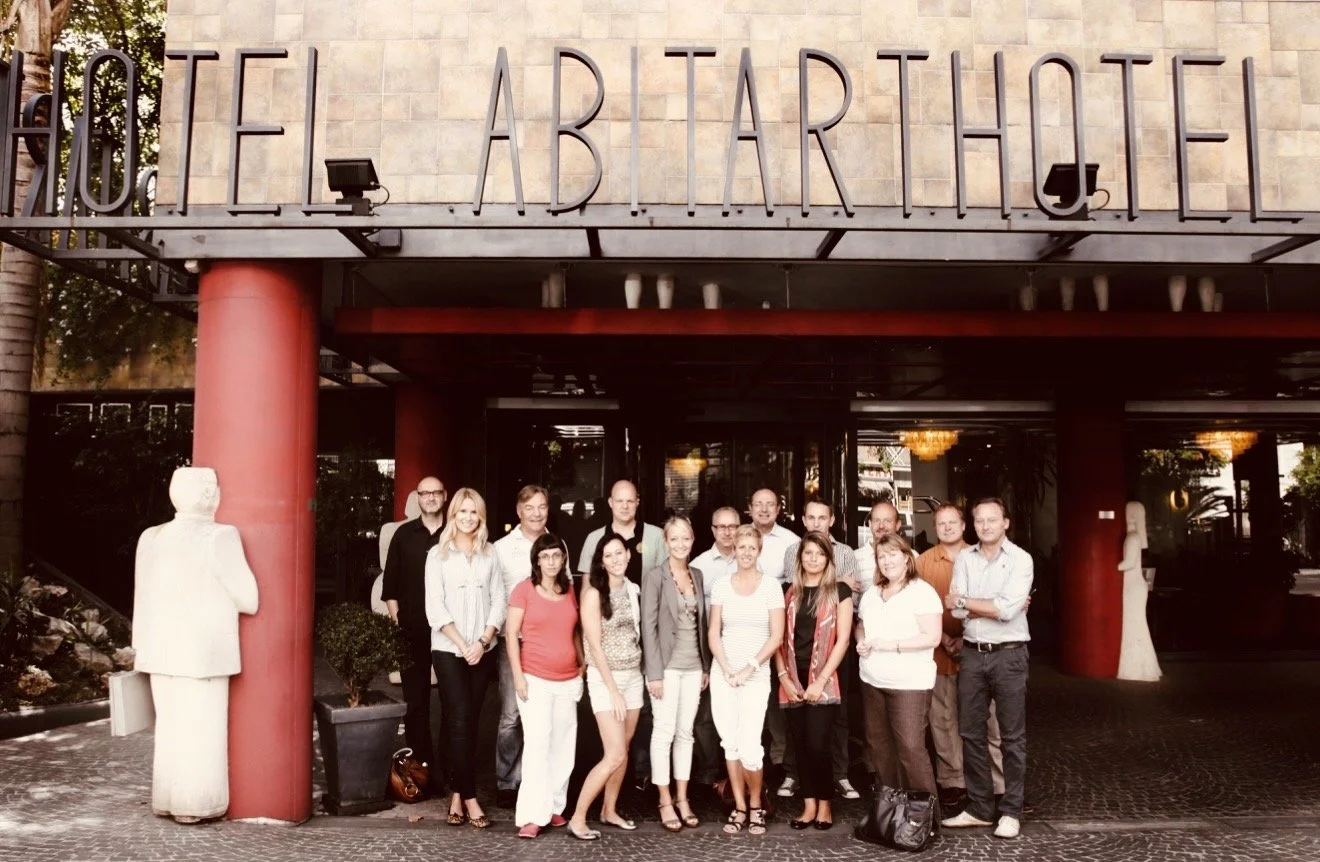
In September 2011, his team hosted one of our international meetings in Rome. I have a photograph of us standing in front of the Hotel Abitart that morning: fifteen Europeans squinting into the sun, Alfredo somewhere in the middle, the other country managers looking like people who do not yet know how lucky they are. I remember three things from those days. The first is the eruption. We were around a table working through the year ahead when, at some point on day two, Alfredo could not bear it any longer and rose halfway from his chair to deliver his thunderclap. No, this is wrong, this is not how we should be doing this, we need to do something completely different. What rose in him at those moments was less anger than conviction, with the volume turned up to a level the rest of us were not equipped to reach. After thirty seconds he would sit back down and the meeting would resume, and an hour later he would be his soft self again, making sure your coffee cup was full. By the third or fourth year we expected it. People would catch each other’s eye as the moment approached, the way you wait for thunder you know is coming.
The second thing is the evening on the terrace in Trastevere. He had reserved a long table in one of those narrow streets where the cobbles glitter. We ate ribbons of cacio e pepe and drank a red wine the waiter recommended without showing us a list, and Alfredo sat at the head of the table the way a man sits when the room he has built around himself is finally serving its purpose. Life tasted, that night, of pepper and pecorino and the warmth of having been included.
The third is the walk we took on the other evening, down from the Monti side into the Forum. Back then you could still enter at night, without a ticket, without a fence, and we descended the stairs as the sun was setting and Rome was turning its evening lights on one by one. Cypresses against a deepening sky. The brick arches of the Basilica of Maxentius leaning into the dusk. Past the Forum, the Colosseum rose above the trees, somehow still standing where it had been put. We walked slowly, talking in low voices, the way you do when a place is teaching you something you did not know you needed to learn.
The same eruption that detonated in our meetings could also detonate in his car. He would be driving through Milan traffic, perfectly composed, mid-conversation, when a driver would do something unforgivable in the next lane, and Alfredo would turn his head and shout at the closed window of a car that could not hear him, then turn back to the conversation as though nothing had happened. The eruptions were the only thing he did not choreograph.
His office wrote on a Friday in November 2016 to confirm that Monday’s invoices would be paid. Seven weeks later he was dead. The news arrived on a Thursday night in January and used the word suddenly. A heart attack, was what we eventually understood. Alfredo had been running on coffee and urgency for a long time, and the body keeps count.
Mieke - our community manager at the time - and I flew to Bergamo together two days later and drove south through the Cremasco countryside, flat winter fields under a pale sky, the hedgerows bare. We had landed an hour later than planned and were going to be late. Vaiano Cremasco appeared: a sudden bell tower, a piazza, a church with people already gathered outside. We parked, walked quickly, and slipped in through the side door with maybe two minutes to spare, into a church that was already full.
Every seat had been taken and every square metre of standing room around the seats had been taken, and the only place left for two foreigners who had flown in that morning was at the side wall, with our coats still on. I recognised faces almost immediately. Marcello, the very first Italian we had nominated for the European CIO of the year award. Enzo from Ferrero, who always sent a Christmas hamper to our Mechelen office that would have fed a small village. Paolo, who taught at Bocconi and had been on the advisory board since the beginning. They were here on a Saturday morning in January to bury a man none of them owed anything to except a kind of quiet love.
Afterwards, the whole congregation walked out of the church and continued, still on foot, to the cemetery next door. In Belgium there is a controlled distance between the church and the grave, and a coffee afterwards where everyone exhales and the family is given permission to be human again. In Vaiano Cremasco there was no distance and no permission. We stood in the cold open air beside the family vault while two cemetery workers in plain working clothes manoeuvred the coffin into its place in the wall. There was no music and no euphemism, just the scrape of stone on stone, the unsoftened plainness of an Italian burial that does not let you look away.
Mieke and I were going to fly home the same day. We had no plans beyond the cemetery. But somebody from the family said that since we had come so far we should come to the house for a coffee, and we said yes because there was nothing else honest to say. We drove with them the short distance to the family home. We sat in a living room I can still reconstruct in detail, it was warm and full of relatives, and Tiziana, his widow, made us a small coffee with hands steadier than they had any right to be. The son was there. The daughter was there. We talked about the day-two eruption, the moment in every international meeting when Alfredo would briefly become the volcano, and the whole room laughed, and Tiziana laughed too. Sì, era proprio così - yes, that was exactly him.
CIONET Italia went through a difficult period after he died, and is now thriving again in the hands of Francesco: il mio nuovo amico italiano, who carries the same warmth Alfredo had and runs the community with the same instinctive grace. Communities survive their founders. Businesses adapt.
What has stayed with me since is the discovery, in a stranger’s living room in the Cremasco countryside, that the line between business and friendship is not where I had thought it was. You spend twenty years meeting people across a conference table. You assume the relationships are the ones you have catalogued: useful, productive, cordial, occasionally affectionate. And then one of them dies and you find yourself accepting a small coffee from his widow, and you realise the catalogue stopped being accurate somewhere along the way. He was not, it turned out, my Italian business partner. He was my Italian friend, who happened, for seven years and three months, to be in business with me.
I am sitting on a small balcony in Rome as I write this last paragraph, the late evening air carrying the smell of pines and someone’s open kitchen window. Tomorrow I will walk down to the Forum again, which is now fenced and ticketed and shut at six. The columns are still standing. The Colosseum still rises above the trees. The cypresses still cut their dark shapes against the sky. And somewhere in the Cremasco countryside, in a cemetery I have visited only once, a stone bears a name I will continue to think about whenever an Italian city, on a soft evening, briefly remembers him to me.
Il mio amico Alfredo.
