
Teleportation and a Red Light in Rome
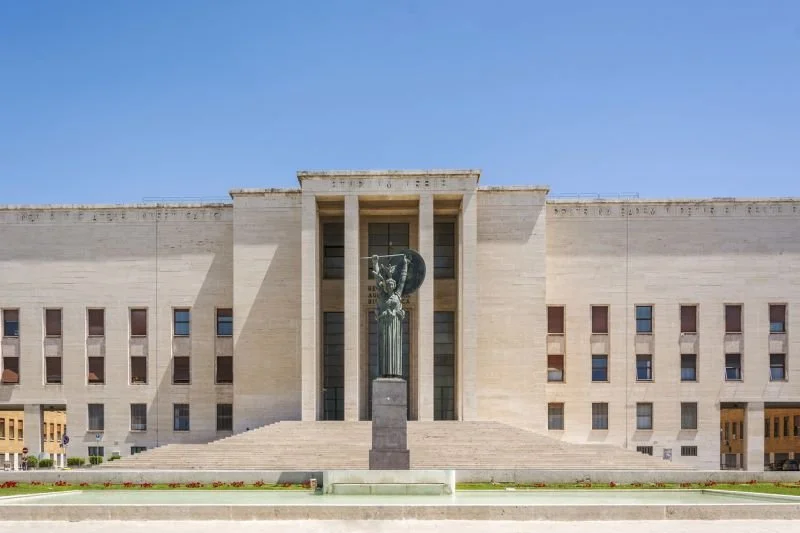
The taxi stops at a red light near the Viale dell’Università, and I look up from my phone.
Through the window: La Sapienza. Founded in 1303 by Pope Boniface VIII, making it one of the oldest universities in the world, with yearly more than 110,000 students passing through its gates. The campus itself dates from 1935, commissioned by Mussolini and designed by Marcello Piacentini in the rationalist style he favoured: wide symmetrical facades, colonnaded archways, cream-coloured stone arranged with the architectural confidence of a regime that intended to last forever. The regime did not. The university did.
I have been reading about what happened here last December. Across this campus, from the Marconi building to the Fermi building, 270 metres of open Roman air between them, a team of physicists teleported quantum information. Let’s try to understand what that means, because the word teleportation is doing a lot of misleading work in that sentence.
Everything that travelled was only informational. The quantum state of a photon: its polarisation, its orientation, encoded in its properties at the moment of transfer. The original was destroyed in the process, and a corresponding state was reconstructed at the destination with fidelity high enough to beat the classical limit by more than ten standard deviations. At this level of description, there is no meaningful difference between a particle and the information that defines it, and they are, in a sense that takes a while to sit with, the same thing.
Your instinct, and mine, is to say: but surely the original and the copy are two different things. At the quantum level, that instinct is wrong. Quantum physics does things to our thinking that we can only describe as mild vertigo, and the reason is simple: the conclusions refuse to fit inside the categories that everything else in life has taught us to use.
What made the Rome experiment significant was the hardware. Most earlier demonstrations used the same source for both ends of the channel, which works in a controlled laboratory and nowhere else. The Rome team used two entirely independent quantum devices, fabricated by different groups in different countries, actively tuned to cooperate with each other across open urban air with all its turbulence and temperature swings and ambient noise.
The light turns green, and we move on.
Three months earlier, I was sitting in an old brewery hall turned event location in Leuven, where CIONET had brought together a room full of digital leaders, who understand technology and are professionally obliged to stay ahead of it. I know the particular quality of attention that settles over an audience when someone on stage says something that genuinely stops the room, and it settled that evening during an explanation of what quantum computing actually is, and what it will do. A woman two rows ahead of me lowered her phone to her lap, and someone behind me exhaled slowly.
A classical computer processes information as bits, each one a zero or a one, a switch either off or on, and its power comes from doing this very fast across many switches simultaneously. A quantum computer uses qubits that can exist as zero and one simultaneously, in superposition, until the moment of measurement forces a choice. Entanglement connects distant qubits so that the state of one is instantly correlated with the state of another, no matter how far apart they are, and this allows a quantum machine to manipulate probability amplitudes across a vast state space in ways that classical systems cannot efficiently reproduce.
I sat there and felt the familiar sensation of a category failing: the same slight tectonic shift I felt the first time I truly grasped that the world works differently from the way we were taught it does, that the rules we learn as children are approximations, useful at human scale and quietly wrong at others. Classical computing is fast, but quantum computing is something else entirely, solving problems that classical computing cannot approach within any useful timeframe. I took notes on my phone and stared at them on the drive home, thinking: I need to understand where this is going.
Now in a taxi heading to the airport, I pull up the research and scroll through the projections. The consensus for the 2030s is that quantum systems will begin to outperform classical computers on specific, commercially significant problems. Most of the encryption protecting the internet today relies on mathematical problems that classical computers find extremely hard to solve, and a quantum computer solves them easily, which is why state actors have been intercepting and storing encrypted communications for years in anticipation of exactly this moment. The technical term is harvest now, decrypt later, and the countdown has begun.
By the 2040s, it is plausible that a quantum computer will finish a molecular simulation that a classical computer would have taken longer than the age of the universe to complete, modelling the precise folding behaviour of a protein implicated in a disease that has resisted treatment for decades. The target will reveal itself, a compound will be identified, and the trial design will be optimised by a system modelling thousands of configurations before a single patient is enrolled.
The gap between the 2020s and the 2040s is the distance between a diagnosis with no answer and one with one. Some people will cross it in time. Others will arrive too late. That is the only thing about this story that makes me sad.
The road south toward Fiumicino opens up ahead. They named this airport after Leonardo da Vinci, the man who sketched the first helicopter design in 1480. Five centuries between the idea of flight and the terminal building. Rome does it again.
The red light in Rome was a threshold, and the experiment that happened on that campus was one of the necessary steps toward a world that computes and communicates in ways that still, even now, feel as though they should be impossible.
The ground has shifted. I felt it first in a brewery hall in Leuven, then at a red light in Rome, and I suspect I will keep feeling it.
The taxi pulls up to the departures terminal. I close my phone and get out.
