
In Silence We Drove Home
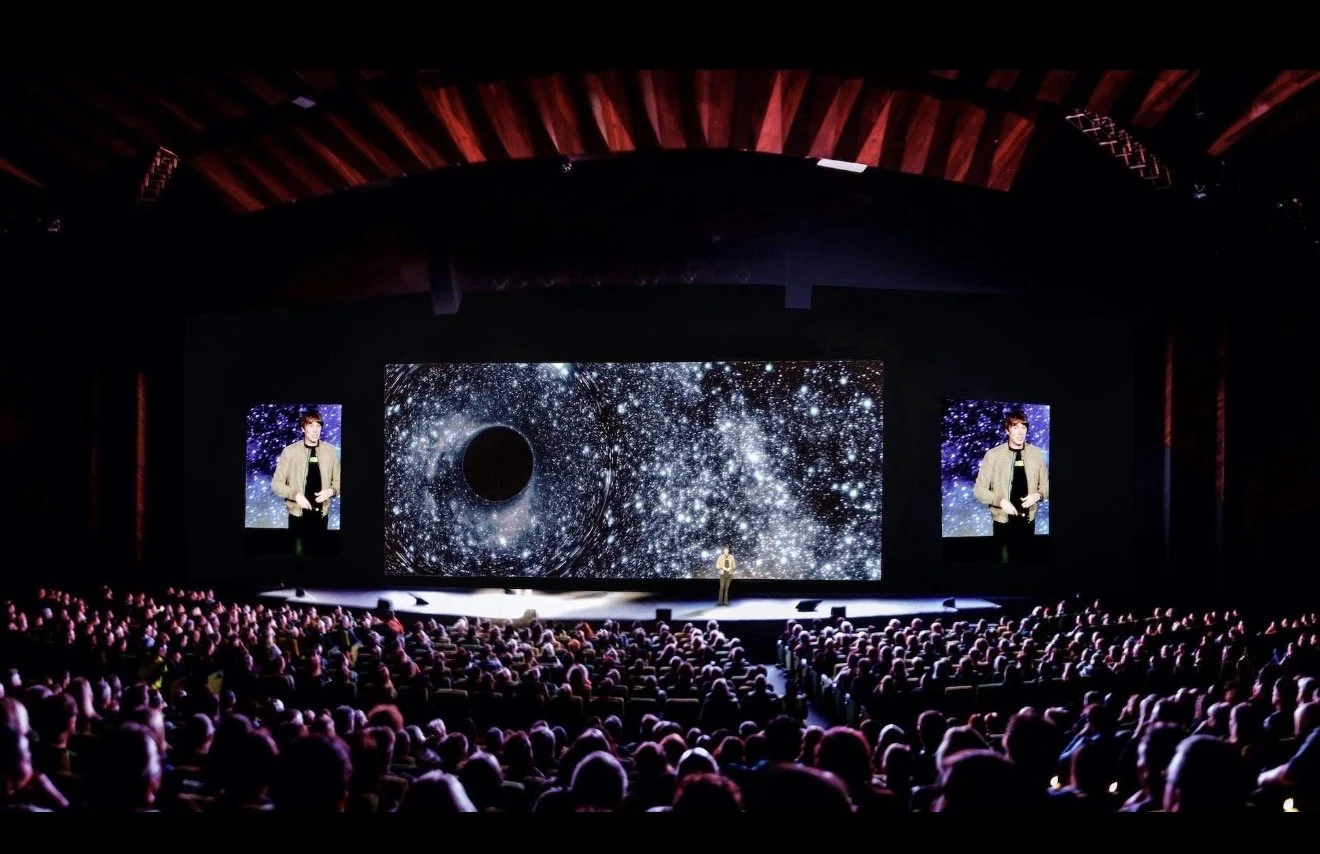
Max and I walked out of the Cirque Royal into a Brussels April evening, and for a while neither of us said anything at all, the pavement still wet from earlier rain, taxis drifting past in no particular hurry, my mind still somewhere inside the theatre and several hundred million light years from where my feet were standing.
We had been to see Brian Cox’s Emergence, described as one of the most ambitious live productions any physicist has attempted.
I have been following Cox for years, through the BBC series, the books, the interviews, admiring from a distance the particular gift he has for making difficult things feel urgent rather than merely interesting. It was the first time I saw him live.
Emergence is built around a question that Kepler asked in 1610 when a snowflake landed on his arm on Prague’s Charles Bridge: why six sides? Why that particular order, arising from nothing, every time? Four centuries later the answer runs from water molecules down through atoms to quarks and electrons, to forces described by quantum theory, and then back upward again to galaxies and solar systems and biology and the fact of a theatre full of people sitting in the dark trying to understand where they came from.
Cox does all of this on screens the size of buildings and with a calmness that borders on the miraculous. He explains things that would have sounded like mysticism a century ago without raising his voice, without asking the audience to relax their standards for evidence.
What he has, and what very few scientists actually possess, is the ability to make the universe feel personal without lying about it.
I was about twenty when I first encountered Carl Sagan, and the circumstances were ordinary enough: Cosmos was on Belgian television, those long Sunday evenings when broadcasting still took its time, and something about his voice and his extraordinary patience got through to me in a way that the biology lectures at university, for all their rigour and precision, did not quite manage on their own. I was studying cells and classification systems and the mechanics of inheritance, and Sagan was doing something else entirely: he was showing me that the story which explained a bacterium also explained a galaxy, that the universe was not a collection of separate academic disciplines but one long unbroken argument, running from hydrogen to consciousness over thirteen billion years, without a single gap that required anything other than physics and time. I had not yet begun the slow work of examining what I actually believed. Sagan did not tell me what to think. He showed me the size of the question, and then trusted me to sit with it.
Cox does the same thing now, for a different generation, in a different register, with better screens. Watching him pace across the stage in Brussels, I thought: the chain still holds, curiosity passed from one mind to another across decades and languages, surviving the machinery of distraction we have built so efficiently around ourselves.
Emergence takes its name from a particular kind of miracle: the fact that complexity arises from simplicity without anyone arranging it, that a snowflake and a brain and a civilisation all follow from rules that do not know they are producing anything, and that the result of this blind, patient process is an elderly universe which has, in one small corner, become aware of itself and curious about its own origins.
Cox puts this on a screen several storeys tall and describes it honestly: no metaphysical inflation, none of the false comfort that the subject tempts people toward. The universe is vast, it is indifferent to us specifically, and it produced us anyway, by accident, over an incomprehensible stretch of time during which almost everything that tried to live failed and vanished and left nothing behind. That is the actual situation, and it is stranger and more interesting than any of the alternatives that have been proposed over the centuries.
Somewhere in the second half of the show, Cox turned to the Fermi Paradox: the silence.
Our galaxy contains 400 billion stars, many older than the sun, many with planets. The time available for life to spread and leave traces is enormous. When we look outward we should be hearing something. Instead: nothing. No signals, no structures, no evidence that anyone preceded us through this particular door.
One explanation is the Great Filter: somewhere between lifeless matter and a civilisation capable of spreading beyond its own solar system lies an obstacle that almost nobody passes. It might lie behind us, in the rarity of life itself. Or it might lie ahead, in the possibility that technological species tend to destroy themselves before they mature. As a biologist, what strikes me is that the bottleneck is not intelligence. Crows solve problems. Octopuses remember faces. The bottleneck is something intelligence does not guarantee: the ability to take seriously what you cannot immediately feel.
Walking through Brussels after the show, I found myself thinking not about civilisations in the abstract but about the specific and ordinary fact of the evening: a father and his son, in a theatre, watching a physicist explain the origin of everything to a few thousand people who had simply chosen to spend an evening this way, and wondering whether Cox was to Max what Sagan had been to me at that age.
Cox fills theatres. He fills arenas. There are people who will never voluntarily read a peer-reviewed paper who will sit in the dark for two hours and let someone explain quantum theory to them, because the person doing the explaining makes them feel that it matters personally, that it has something to do with them, that understanding it is not a specialist activity but a human one.
That is what Sagan understood, and what Cox has inherited. What Sagan did with Cosmos was not merely educational in the way a good textbook is educational: he changed the emotional position of millions of people inside the universe, made the cosmos feel vast without making humanity feel pointless, made the scientific account feel not like a cold correction to the stories we tell ourselves but like a better and more astonishing story than any of them. When he spoke about the pale blue dot, you found yourself thinking differently about everything, about the things we argue over, about the amount of energy we spend on questions that will not outlast us. I felt something like that at twenty, watching him on television in a household that still said grace before dinner, still not sure what I believed or whether I had the right to examine it. I felt something like it again that evening, at sixty-two, in the Cirque Royal, with Max beside me.
The motorway out of Brussels curves north through the light pollution of the ring road before the sky opens a little, and I was driving, and Max was looking out of the passenger window at whatever stars the clouds and the streetlights permitted. Neither of us knew we didn’t need to say much. The show was still in the car with us, taking up all the available space.
Somewhere above the motorway, the universe continued in every direction, mostly empty, mostly dark, waiting to see what we would do with the accident of our existence.
In silence we drove home, looking for the stars.
