
The Mould and the Manuscript
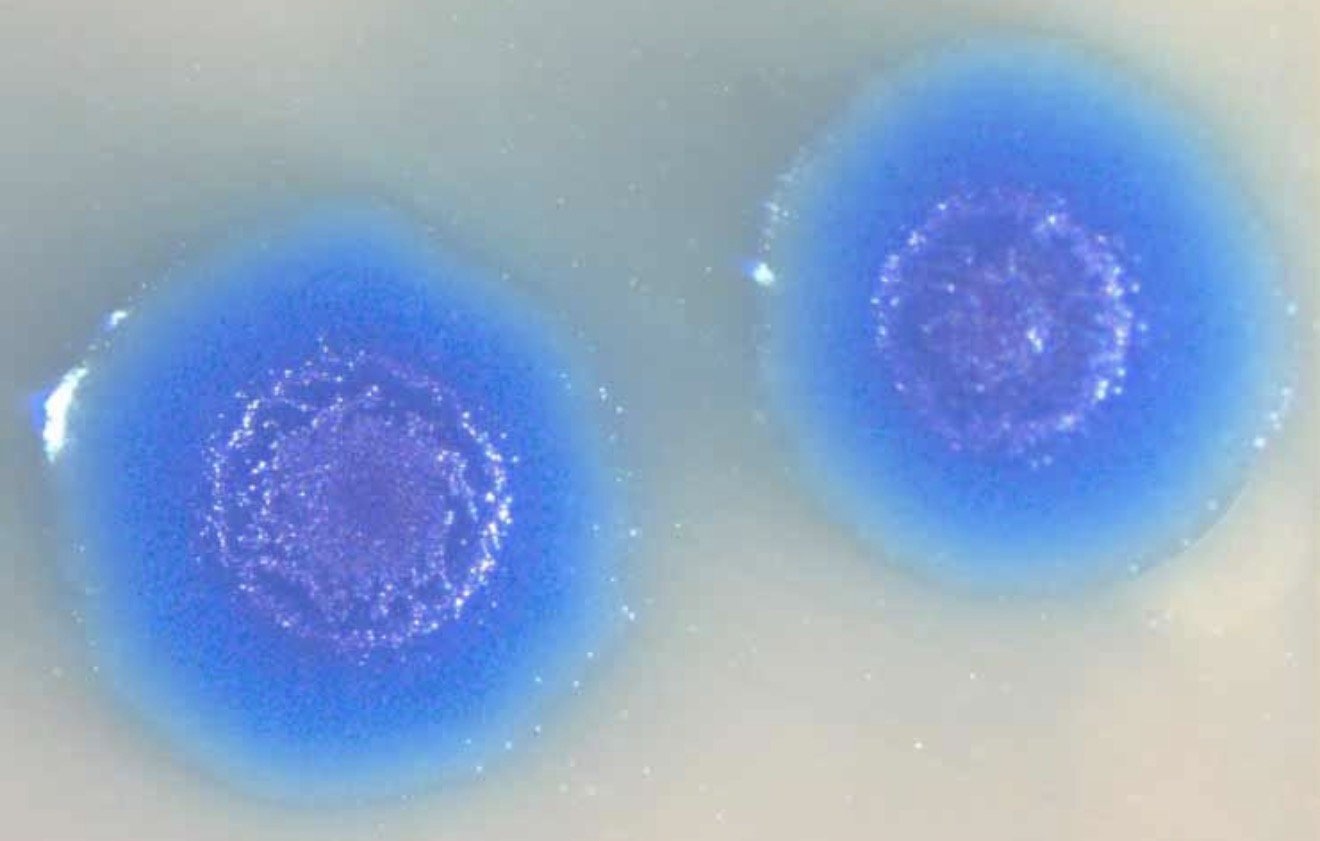
We buy our bread from a sourdough bakery in our street. It is, without question, the best bread in the world: the crust shatters when you break it, the crumb is dense and chewy and faintly sour in the way that makes you want another slice before you have finished the first, and the smell when Hilde cuts it in the morning reaches me before I am fully awake. The health credentials are genuine too: slow carbohydrates, long fermentation, a fermentation tradition that has been shaping bread and human digestion before anyone thought to call it a probiotic.
But it moulds. Quickly and without apology. Two days in the bread bin and the white spots appear. I stand over the loaf every now and again making the same uneasy calculation: is this still in the safe zone, or has the loaf crossed it? I cut around the visible patches, suspecting I am fooling myself. Usually I eat the bread anyway. Sometimes I throw it out, feeling guilty about the waste.
What strikes me, when I stop and think about it, is that the mould is alive. It is an organism eating my breakfast: a colony of fungi growing methodically through the crumb, following gradients of moisture and sugar, obeying instructions encoded in its genome long before this bakery existed, long before our species learned to bake anything at all. The whole transaction, from the yeast that made the bread rise to the fungi patiently reclaiming it, runs on the same ancient molecular language: four chemical letters, arranged in a sequence, telling each cell what to build, what to break down, when to divide, and when to stop.
For most of human history, that language was something we could observe but never touch. We could see what it produced. We could not rewrite it. We could breed dogs slowly, nudge evolution by selecting which animals reproduced, cross tulips and grape cultivars over generations of patient agricultural persuasion, but we were still entirely at the mercy of what was already there. We were readers of a text we had not written, working with vocabulary we understood only in fragments.
In 2010, that changed. A team led by Craig Venter took the genome of a bacterium, a stretch of DNA roughly one million letters long, and moved the whole sequence into a computer, edited it digitally to add their names alongside a quote by Richard Feynman, manufactured the DNA chemically from shorter synthesised fragments stitched together through overlapping sequences, and inserted the finished chromosome into a living bacterial cell from a related species whose own genome they had first removed.
The cell read the new instructions. And it obeyed them. It divided. It reproduced. The synthetic text had taken command of the hardware, and the hardware had done exactly what the text said.
The moment I find most remarkable is not the assembly itself, spectacular as it was. It is what happened when the synthetic chromosome was inserted on the first attempt and the cells simply refused to grow. The team spent weeks hunting the error, constructing hybrid genomes, narrowing the problem down through anxious elimination, until they found a single base pair missing in a critical gene responsible for initiating DNA replication. One letter, out of more than a million, had been dropped during the initial chemical synthesis, shifting the reading frame and producing a nonsense protein the cell could not use. Forty million dollars and fifteen years of accumulated method, stopped cold by a single typographical error in a manuscript of a million characters. When they corrected it, the colonies appeared within days.
I think about this precision when I look at the mould on the bread, that colony spreading quietly across the crust while I deliberate about whether to eat around it, operating on a genome of roughly ten million base pairs, every one in the correct position, maintained across uncountable generations by molecular proofreading systems that took billions of years of evolution to refine. And we still do not understand all of it. When Venter’s team later tried to identify the minimum number of genes required for life, they found that roughly a third of the genes that could not be removed without killing the cell had no known function whatsoever. They are indispensable, and we have no idea what they do. The mould is running machinery we cannot read, even now, even after everything we have learned.
And yet we can write it. This is the strange loop at the centre of synthetic biology: we have learned to author a language we have not yet fully understood, to compose sequences and instruct cells to obey text assembled at a keyboard, while still ignorant of what a third of the most essential words in that text actually mean. We are somewhere between a child copying letters and a poet who has spent decades with the dictionary. The alphabet is in hand. The complete vocabulary is still being assembled.
Venter’s work did not remain a demonstration. In the sixteen years since, the ambition scaled in ways that are difficult to absorb. An international consortium has now synthesised all the chromosomes of brewer’s yeast, including one that has never existed in nature, a significant step toward the first fully synthetic complex cell, though the work of consolidating those chromosomes into a living organism is still ongoing. Others have rewritten a bacterium’s entire genetic code, more than a hundred thousand individual changes, producing a strain that natural viruses simply cannot infect because they can no longer read the instructions. And in work that reads more like science fiction than settled science, researchers earlier this year reported rebooting a cell whose own genome had been chemically silenced using a synthetic donor genome inserted in its place. A living cell from a dead chassis, if the results hold.
Meanwhile the applications arrived without fanfare, and some of them you have already used. The mRNA vaccines that went into hundreds of millions of arms during the pandemic were synthetic biology: a new pathogen appeared, researchers wrote a molecular response within days, and human cells read the instruction and acted on it. The Impossible Burger bleeds because someone wrote an instruction telling a yeast cell to produce the protein that makes meat look and taste the way it does. Microbes are being engineered to eat plastic; the first industrial-scale biological recycling plant for PET is expected to open before the end of this year.
Venter’s team spent fifteen years and forty million dollars on one bacterium. Current researchers use machine-learning systems to close the loop between design and result in days. Governments have noticed: synthetic biology is now a strategic national asset and an industrial policy priority for several major powers. Some forecasts put the global market at twenty billion dollars today, rising to somewhere between fifty and a hundred billion within a decade.
I find myself back at the bread. The mould does not know any of this. It has not followed the literature. It is doing what it has always done: reading its inherited instructions, following the chemistry, advancing across the crust with no interest in the questions its existence raises. It is evolution’s work, running exactly as written, billions of years before we learned to read it, and sixteen years after we learned to write it ourselves.
For centuries we asked what life was. Venter’s experiment added a more dangerous question: what should life become? And underneath that one, quieter and harder: do we have the wisdom to answer it well, before the writing outpaces the understanding?
The field is moving fast. The wisdom is moving at a different pace. And somewhere, as I write this, an AI system is designing organisms that evolution never produced, life forms composed rather than found, written rather than bred, optimised for purposes we chose. I do not know what those organisms will do. Nobody does yet.
But I allow myself one small, domestic hope: that one of them turns out to be a sourdough culture that does not mould. I would buy that bread.
