
The Beautiful Weight of Remembering
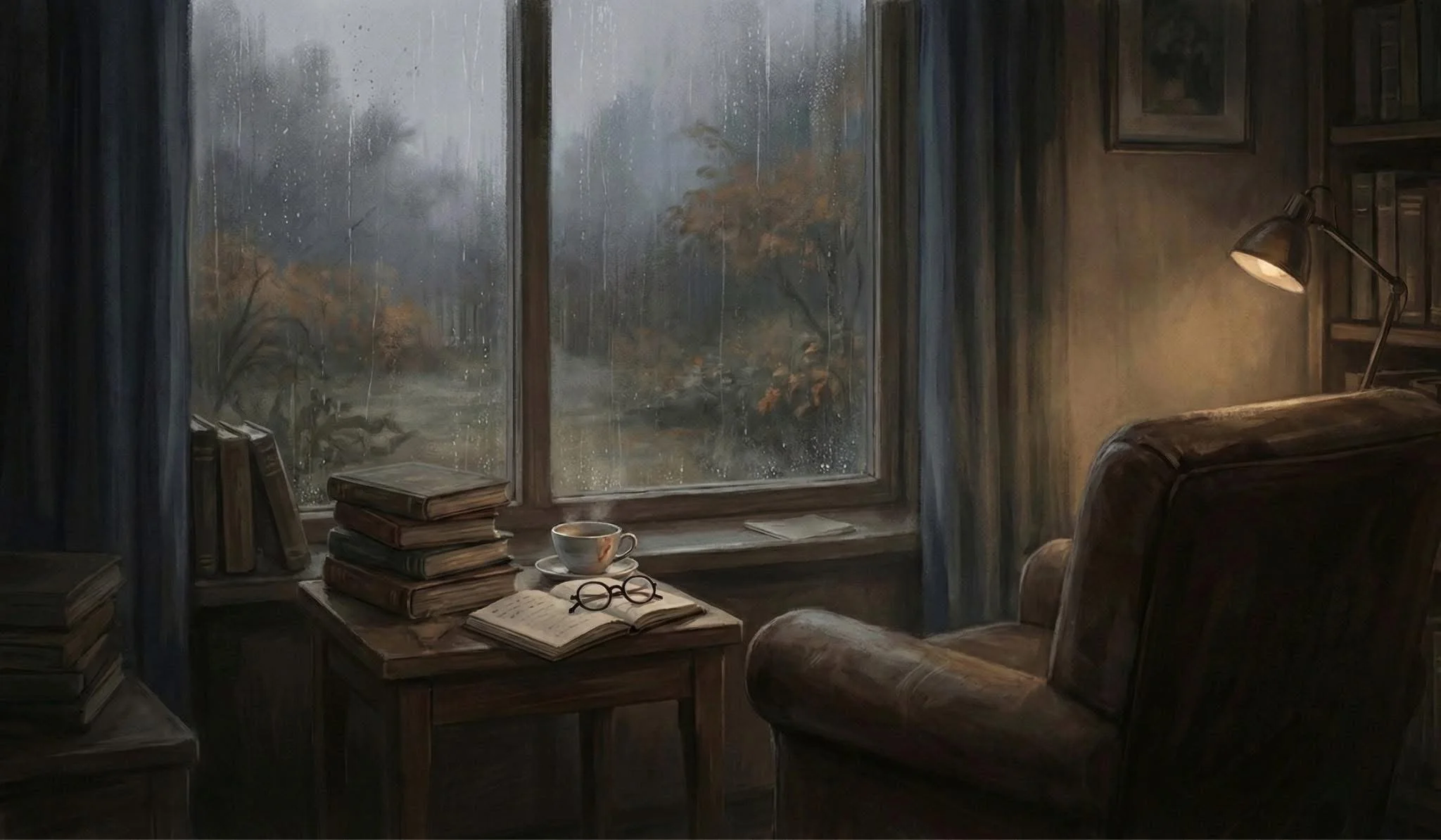
There is a particular kind of sadness that does not want to be cured. It arrives uninvited, often in the late afternoon or the sleepless hours after midnight, and it brings a strange gift: the ability to feel the full weight of a life being lived. This is melancholy. Not the flat grey of depression, but something textured and almost nourishing in its depth.
The Romans called it desiderium, the ache for what is absent. The Welsh speak of hiraeth, a homesickness for a home you cannot return to, perhaps one that never really existed in the form you remember it. Any culture that lives long enough invents words for this feeling, because every culture eventually learns that loss and beauty are inseparable.
I have been thinking about this. I have been assembling music that matches the weather inside me.
Nick Drake’s “River Man” comes on, and I am immediately elsewhere. The waltz time drift, the strings that rise like fog from English fields. Drake understood something most songwriters miss, that melancholy is not the absence of beauty but its most concentrated form. It swallowed him in the end, but the songs remain, proof that he saw something true before the seeing became unbearable.
Melancholy needs three ingredients: sadness, beauty, and memory. Take one away and you have something else. Sadness alone is only pain. Beauty alone is pleasant but thin. Memory alone becomes nostalgia that easily tips into sentimentality. Combine them, let sadness be shaped by the memory of something beautiful, and you reach melancholy’s particular territory, grief that is somehow grateful for having had something worth grieving.
I am not in despair. The despairing do not curate playlists. They do not place one song after another to build an architecture of feeling. This is something different. This is taking stock. This is a man who has accumulated enough life to have material worth mourning.
Charles Aznavour begins to sing. Hier encore, j’avais vingt ans. Just yesterday, I was twenty.
The French seem to carry this better than the English. The way hier encore sounds, urgent and slightly accusing. Just yesterday. Where did the years go while I was busy becoming someone else?
I think of my mother.
She loved me unconditionally. That is what mothers are meant to do, although not every child is lucky enough to feel it so fully. We never said the words. That was our generation’s style, love expressed through presence and through doing, through the accumulated evidence of years rather than declarations. The words would almost have felt redundant. Perhaps even embarrassing.
She died too early. It is always too early, but there is a particular cruelty when someone leaves before the chapters in which things finally come together. She saw the child, the student, the young man still finding his way. She did not see who I became later, the work that finally began to take shape, the man who understood at last what he wanted to say to the world.
She would have been so proud.
That one sentence contains the entire weight of desiderium. The phrase “would have been” carries infinite loss. An imagined pride that can never be confirmed. A witness who is absent from the very achievements she quietly made possible.
Yet the unconditional love she gave did not vanish when she died. It flows through everything I build. I learned from her absence that love can be expressed through making, through patient work, through the slow accumulation of something meaningful. I learned urgency. I learned that the words we did not say must be spoken in some other way.
Johnny Cash is singing “Hurt” now. His voice is ravaged and ancient, yet completely steady. He recorded this song at the end of his life, and that changes it entirely. A young man’s lyrics about addiction become an old man’s reckoning with everything.
“What have I become” is not a theatrical line when you know the end is near. It is a ledger.
I think further back. A village childhood. I was the son of a primary school teacher, which meant being watched and being exemplary, the quiet clever boy who behaved. Every eye on me. A self that developed underground, noting things, forming opinions that were not yet safe to speak.
I have changed a lot since then.
Or perhaps not. The quiet observer became the reader of systems, the noticer of patterns, the one who pays attention to how light falls. The core did not change. What changed was permission. Somewhere along the way I discovered that the observations I had been stockpiling for years could be spoken aloud. That people would listen. That the quiet boy had been gathering something valuable all that time.
He did not disappear. He simply stopped performing correctness and started telling the truth.
Leonard Cohen’s “Sisters of Mercy” plays, and I let it wash over me. Cohen always sounded old, even when he was young. He understood that comfort and sorrow are not opposites. The sisters in the song do not rescue him, they keep him company in the dark. First they offer shelter, then they give him a song to carry away.
This is what the melancholic knows that the merely sad does not. The longing itself is proof of richness. You cannot miss what you never had. You cannot mourn what never mattered. The ache is the residue of beauty. It is love still working, long after its object has gone.
The Welsh word hiraeth points to something important. We do not only long for people and places we have lost, but also for versions of ourselves we can no longer be. The child in the village. The young man whose mother was still alive. The person I was before I understood that everything passes.
The playlist ends with José González, his voice barely above a whisper. “Heartbeats”, a reimagined electronic song, stripped to guitar and breath. He sings of a single night that changes the truth of things, and you believe him completely.
Late at night, when sleep refuses to come, I do not fight these visitations. I let them arrive. My mother. The village. The quiet boy. The years that slipped past while I was busy becoming someone else. Melancholy is not a problem to solve. It is a capacity to honour. The person who cannot feel it is impoverished, unable to hold loss and gratitude in the same moment.
Just yesterday I was young. Just yesterday she was alive. Just yesterday I was a clever boy in a village, watching, waiting, not yet knowing what all that watching was for.
The music stops. The silence that follows is not empty. It is full of everything that was, and everything that remains.
For the mothers who never heard the words, but knew anyway.
P.S. Here’s the playlist behind the words. In the order the feeling unfolds:
1. Nick Drake – River Man
2. Charles Aznavour – Hier encore
3. Johnny Cash – Hurt
4. Leonard Cohen – Sisters of Mercy
5. This Mortal Coil – Song to the Siren
6. Charles Aznavour – La bohème
7. Rodríguez – I Think of You
8. Rodrigo Amarante – Irene
9. Jackson C. Frank – Blues Run the Game
10. Nick Drake – Day Is Done
11. Nico – These Days
12. Bill Callahan – Jim Cain
13. Mari Froes – Fogueira
14. Mari Froes – Moça
15. Norah Jones – Shoot the Moon
16. Rodríguez – Crucify Your Mind
17. Mari Froes – Eu
18. Fleet Foxes – Tiger Mountain Peasant Song
19. J. J. Cale – Magnolia
20. Norah Jones – Come Away With Me
21. José González – Heartbeats
