
The Forest Inside: How Many Terabytes Is a Life?
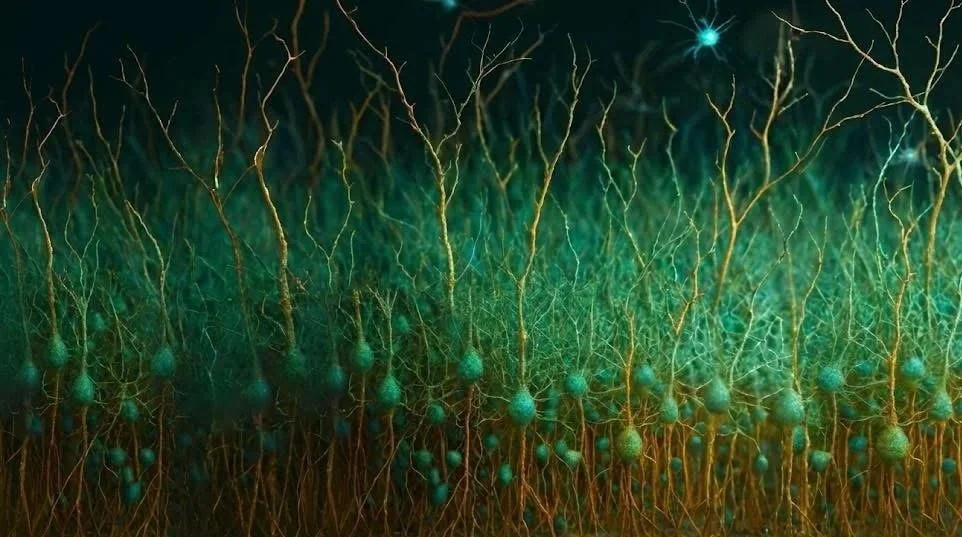
This morning I was thinking about my brain when a strange question surfaced: how many terabytes would I need to store everything in my head? So down the research rabbit hole I went.
I came across an image and description of a one-cubic-millimetre scan of human brain tissue at extreme resolution. Within that tiny cube there are thousands of neurons and a dense forest of branches and connections. To capture that single cubic millimetre, researchers needed about 1.4 petabytes of data, roughly the same as fourteen thousand full-length films in 4K quality.
For a volume of brain smaller than a grain of sand.
One cubic millimetre.
Your brain contains around a million of those tiny volumes. To map the entire brain at this resolution you would need data on the order of the world’s digital storage. Not just your files. Everyone’s. At some point the exact number stops being meaningful. It is simply far beyond what we can practically store or process today.
And that is only the structure.
These scans show where the cells and connections are. They do not capture the electrical activity, the changing strength of each synapse, or the chemical conversations between cells. They are the blueprint of the house, not the party going on inside.
So when we ask how many terabytes a brain would need, there are really two answers.
The first: we do not know. Neuroscientists can estimate how many neurons we have, how many connections, how many bits you might need per synapse, but it remains guesswork. Depending on the assumptions you use, you end up somewhere between a very large hard drive and many data centres.
The second: it is the wrong question. The brain is not a hard disk that stores static files. It is a living system that rewires itself as you learn, forget, sleep, walk, argue, and read essays like this one. It is closer to an ongoing process than a container full of data.
Still, the numbers are useful. They give a sense of scale.
We complain that our phones are full, while the device in our skull quietly runs a biological supercomputer. It runs on about twenty watts of power. It updates itself every night. It has stored every language you speak, every face you recognise, every route you can walk without thinking.
All of that packed into a silent organ that, from the inside, simply feels like ‘me’.
Thinking about that one cubic millimetre, I feel two things at the same time.
First, a sense of awe. Whatever we are, we sit on top of an astonishing level of complexity. Every thought we have is the result of countless small physical events in that forest of cells.
Second, a sense of responsibility. If the hardware is this rare and this powerful, then how we use it matters. What we pay attention to. What we practise. What we feed our body and mind every day.
Maybe the better question is not how many terabytes your life would need. Maybe the better question is what is worth storing there at all.
