The Formula for Lived Success
Why achievement alone never feels like enough.

Success feels solid until you try to hold it. Everyone knows when they want it. Few agree on what it actually is. We praise it, pursue it, envy it, and sometimes reach it only to discover that it feels thinner than expected. At other times, moments that look unimpressive from the outside feel quietly and deeply successful.
John Lennon reportedly said that life is what happens while you are busy making other plans. The same could be said of success. We spend years constructing careful architectures of achievement, only to find that the feeling of success, the lived experience of it, slips through the scaffolding and settles elsewhere. The promotion arrives and feels hollow. A quiet afternoon in which a difficult problem finally yields feels triumphant. Success does not reliably live where we build houses for it.
That mismatch points to something essential. Success is not only an outcome. It is an experience. And like all experiences, it is shaped less by facts than by interpretation, direction, and comparison.
Philosophers have long suspected this. Aristotle distinguished between eudaimonia, a flourishing life, and hedonia, the accumulation of pleasures. The Stoics went further, arguing that external achievements were preferred indifferents, welcome perhaps, but ultimately irrelevant to the life well lived. What mattered was virtue, which was entirely internal. Two thousand years later, we are still wrestling with the same puzzle. We sense that success is not simply what happens to us. We know it has something to do with how we relate to what happens. What we often lack is a clear way of thinking about that relationship.
Here is one attempt, a model rather than a truth:
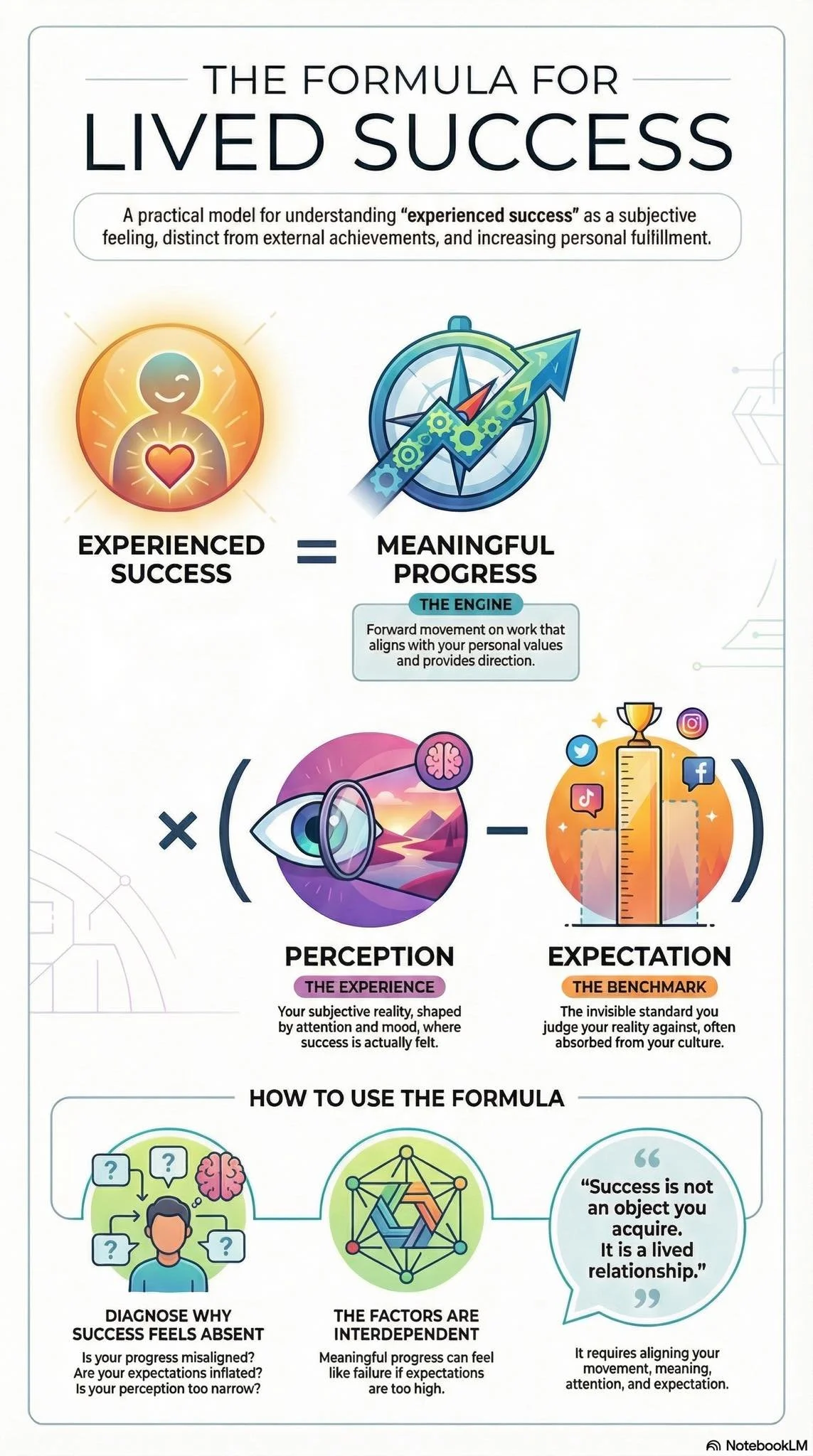
Experienced success = Meaningful progress × (Perception − Expectation)
This is not mathematics in the scientific sense. It is a thinking tool, a lens for examining why effort and satisfaction so often drift apart, and why achievement alone fails to guarantee fulfilment. Its value lies in what it helps us see.
Perception: where success actually happens
Perception is the raw material of lived experience. It is not reality as measured from the outside, but reality as registered by a human nervous system. Attention, mood, memory, comparison, and context all shape it.
Phenomenology made this insight explicit. Edmund Husserl argued that consciousness is always consciousness of something, that experience is not a passive reception of facts but an active construction of meaning. We do not simply see the world. We constitute it through the act of seeing. Two people can encounter the same situation and walk away with radically different experiences. One feels energised, the other deflated. One notices growth, the other notices lack.
Consider a simple example. A person receives praise for a piece of work. On a good day, that praise lands as validation and encouragement. On a day coloured by fatigue or self-doubt, it barely registers, or feels undeserved. The words are identical. The experience is not.
This matters because lived success does not occur in spreadsheets or CVs. It occurs in perception. If perception is muted or distorted, success fails to register, regardless of how impressive the outcome looks on paper. The executive with the corner office who feels like a fraud. The artist with critical acclaim who sees only flaws. The parent whose children are thriving but who remembers only the arguments. Perception is not a window onto success. It is the room in which success lives or dies.
Modern psychology confirms this again and again. We adapt quickly to improvements, returning to baseline satisfaction regardless of what we acquire. We fixate selectively on shortcomings. We remember experiences not as they unfolded, but through emotional highlights and endings. Even our memories of happiness are unreliable. Perception is not a bug in the system. It is the system.
Expectation: the invisible benchmark
Expectation is the comparison point against which perception is judged. It includes hopes, assumptions, promises made to oneself, and silent beliefs about what should happen next.
The Stoics were acutely aware of this mechanism. Seneca warned against the tyranny of hope, not because hope was evil, but because attachment to specific outcomes placed wellbeing outside one’s control. Marcus Aurelius reminded himself repeatedly to expect nothing in the sense of entitlement, to accept whatever came, and to ground his sense of worth in the quality of his judgments and actions rather than in results.
Expectation is powerful precisely because it is often implicit. We carry benchmarks we never consciously chose, absorbed from parents, peers, culture, and the steady drip of images of what success is supposed to look like. When expectations go unmet, disappointment appears without a clear explanation. We feel we have failed without being able to say exactly what we failed at.
Two people receive the same salary increase. One expected nothing and feels pleasantly surprised. The other expected more and feels undervalued. The number is identical. The verdict is different.
Subtracting expectation from perception explains much of everyday disappointment. When perception exceeds expectation, we feel successful. When expectation exceeds perception, we feel let down, even in objectively good circumstances. This is the engine behind the peculiar misery of the privileged, those whose lives improve while their satisfaction declines. Expectations have inflated faster than reality.
The Buddhist tradition placed this insight at the centre of its diagnosis of suffering. Dukkha arises from craving, from the insistence that reality conform to our demands. Relief does not come from acquiring more, but from loosening the grip of expectation.
Yet this subtraction alone cannot define success.
The problem with expectation management alone
If success were simply perception minus expectation, the easiest strategy would be to expect very little. Lower the bar enough and almost anything clears it.
That works emotionally in the short term, but it carries a cost.
Imagine a person who avoids challenge, ambition, and responsibility. Expectations are kept deliberately low to sidestep disappointment. Life becomes predictable and relatively comfortable. Perception often exceeds expectation. By that measure, they feel successful. Over time, however, something erodes. Stagnation sets in. A quiet sense of unused capacity appears. Life feels defended rather than lived.
This is the shadow side of detachment. Epictetus drew a careful distinction between what is under our control and what is not, but he never argued for passivity. The aim was not to withdraw from life, but to engage fully where agency exists, while accepting outcomes with equanimity.
Pure expectation management optimises for comfort rather than vitality. It explains how to avoid pain, but not how to build a life that feels earned and alive. Nietzsche saw this danger clearly. His critique of moral systems that defined the good life as the absence of suffering was, at heart, a defence of creative power and forward movement.
To correct for this, the formula introduces a dimension that cannot be optimised by shrinking expectations.
Progress: success needs movement
Progress is movement through time. It is the difference between where you were and where you are now. It introduces direction and trajectory into the experience of success.
Consider someone learning the piano. Early sessions are clumsy and slow. Objectively, they remain a beginner. Yet they experience satisfaction because yesterday they could not play at all, and today they can. The slope matters more than the height.
This insight appears in many places. Video game designers understand that the feeling of progress, levelling up, unlocking abilities, gaining mastery, is more compelling than the feeling of arrival. Human beings are wired to register forward movement. When effort feels static or circular, motivation collapses. When effort feels like it is going somewhere, engagement persists.
Research on motivation supports this. Studies of flow show that optimal experience arises when challenge and skill are balanced and feedback makes progress visible. Workplace research repeatedly finds that the sense of making progress on meaningful work matters more for engagement than praise or reward.
Progress gives success a temporal dimension. It turns static evaluation into an unfolding story.
But progress alone is still not enough.
Meaningful progress: direction that fits
Progress becomes powerful only when it is meaningful, when movement is directed towards something that aligns with values, identity, and a sense of what is worth caring about.
Progress without meaning can increase status, income, or competence while reducing lived success.
Viktor Frankl built his entire therapeutic philosophy around this insight. Observing human behaviour under the most extreme conditions, he concluded that meaning transforms the experience of difficulty. When progress is tied to a purpose that matters, effort becomes investment. Frustration becomes part of a larger narrative. Sacrifice feels chosen rather than imposed.
Someone advances rapidly in a well-paid career that feels misaligned. Promotions arrive. Responsibilities grow. Satisfaction plateaus or declines. The progress is real, but it does not resonate. Another person advances more slowly in work that reflects their interests and values. Their days are harder, but their sense of success is stronger.
Meaning does not require grand missions. Frankl emphasised that meaning could be found in small acts of care, in love, in the attitude one takes towards unavoidable hardship. The question is not whether your progress impresses others, but whether it connects to something you genuinely care about.
This is why the formula specifies meaningful progress, not progress in general.
Why the equation multiplies
The structure of the formula matters.
Experienced success = Meaningful progress × (Perception − Expectation)
Progress and the perception expectation gap do not simply add up. They amplify or cancel each other.
If perception minus expectation is negative, even meaningful progress can feel like failure. This happens when expectations outrun reality. A person may be building something worthwhile yet feel constantly behind because their internal benchmark is unrealistic.
Consider the writer working on a book that reflects their deepest thinking. The work improves steadily. The project matters. Yet they expect immediate recognition. Early reception is quiet. Perception falls short of expectation. Lived success feels low despite real progress. Success is happening, but it is filtered out by comparison to an imagined outcome.
Conversely, if perception minus expectation is positive but progress is meaningless, success feels shallow. Pleasure spikes but fades quickly because it does not accumulate into a coherent sense of growth. A stretch of indulgence may feel wonderful, but if it connects to nothing valued, it does not become a life.
Multiplication captures this interdependence. Meaningful progress provides substance. The perception expectation gap determines whether that substance registers. You need both.
A concrete example
Consider someone focused on improving their health.
They begin walking daily and training regularly. This aligns with a clear value: energy, mobility, longevity, the ability to be physically present for the people and activities that matter to them. The progress is meaningful.
After several weeks, strength improves, sleep stabilises, and energy lifts. However, the scale has barely moved. Their expectation was visible weight loss. Their perception narrows to that single number, filtering out other signals.
Perception minus expectation becomes negative. Lived success feels disappointing.
Nothing about the progress needs to change. What changes is expectation calibration and perceptual breadth. Expectations adjust to recognise that adaptation precedes visible outcomes. Perception expands to include strength, endurance, recovery, and ease of movement.
The same period is now experienced as successful. The effort was never the problem. The interpretation was.
The levers
The formula highlights three levers largely under personal control.
First, the direction of progress, what you choose to pursue. Second, the meaning of that progress, why it matters to you. Third, the management of perception and expectation, how you interpret what happens along the way.
Ancient philosophy and modern psychology converge here. Focus effort where it matters. Accept uncertainty. Train attention. Treat expectations as hypotheses rather than guarantees.
Success is not an object you acquire. It is a lived relationship between movement, meaning, attention, and expectation.
This formula does not trivialise success. It makes it more demanding. You cannot manufacture it by lowering expectations alone. That leads to comfort without vitality. You cannot force it through achievement alone. That leads to accomplishment without fulfilment. You must move, the movement must matter, and you must learn to see what is actually happening rather than what you assumed would happen.
Experienced success = Meaningful progress × (Perception − Expectation)
When success feels absent, the formula gives you a place to look. Perhaps progress is real but misaligned. Perhaps expectations have quietly inflated. Perhaps perception has narrowed until gains are invisible.
Life is what happens while you are making other plans.
Success is what happens while you are looking for it somewhere else.