
The Formula of Wellbeing
What We Can Learn from Dr. Gerbert Bakx
There are thinkers we follow because they are clever, and thinkers we follow because they say out loud what we already half sensed but had never quite put into words. Dr. Gerbert Bakx is firmly in that second group. His work feels like clear water. You read him and suddenly your own life, your own patterns, come into focus with surprising simplicity. He names the trap most of us live in, chasing fulfilment through achievement while the architecture of genuine wellbeing goes unbuilt.
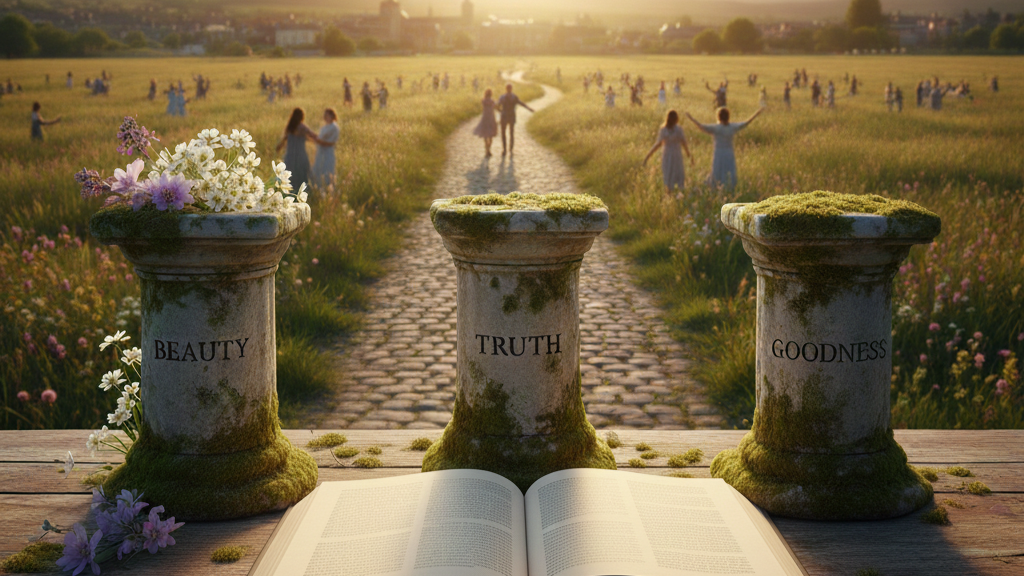
The question he addresses is ancient. Twenty four centuries ago, Plato proposed that a good life rests on three pillars, the beautiful, the true, and the good. These were not decorative ideals but foundational necessities. A life that loses contact with beauty, truth, and goodness becomes unliveable from within, regardless of external comfort. What Bakx does is translate that ancient triad into contemporary language and convert philosophy into practice. His formulas are deceptively simple. Their implications are radical.
He is a physician, psychotherapist and philosopher, founder of the Academy for the Art of Living, and the author of a compact body of work on happiness and living well. De strategie van het geluk is presented as a basic handbook and a unique masterplan for happiness, a way to “leren dansen met het hele leven”, to learn to dance with all of life. Gelukkiger leven. 101 vragen en antwoorden over geluk en levenskunst collects the most pressing questions about happiness and offers careful, responsible answers. Nieuwe levenskunst. Naar een logica van vrede en welzijn voor een waardevoller en gelukkiger leven goes a step further and argues that durable happiness cannot depend on circumstances or events, but must be an active creation of the human being.
All this rests on one central claim. Everything people do is driven by the desire for wellbeing. Happiness. Fulfilment. Call it what you wish. Our entire existence orbits this pull, yet most of us spend our lives chasing wellbeing in ways that can never produce it.
The wrong formula
The world teaches us, insistently, to believe in a very familiar equation:
WB = WE + SU + PL
Wellbeing equals Wealth plus Success plus Pleasure.
If you earn enough, succeed enough, enjoy enough, then you will feel whole. That is the promise that hums below childhood ambitions and adult anxiety. It drives careers, relationships and a great many sleepless nights. We are raised inside this formula. It shapes what we study, whom we marry, how we measure our worth. It appears so self evident that questioning it feels like questioning gravity.
Only the formula is wrong. It does not lead to fulfilment. It leads to filling up. The difference is decisive. Filling up creates a life crowded with achievements and possessions while the inner landscape remains hollowed out. Fulfilment creates a life that may look modest from the outside but feels coherent and alive from within.
Consider two lives. One person climbs steadily, better job, larger home, impressive credentials, exotic vacations, admiring acquaintances. Yet at night, staring at the ceiling, they feel curiously vacant. Something essential is missing, though they cannot name it. Another person lives simply, works steadily at something they care about, finds beauty in small moments, maintains a few deep friendships, and radiates a calm contentment that puzzles those still climbing. What separates them is not wealth, success, or pleasure. It is the formula they are living by. The external variables were never the decisive ones.
We see this everywhere once we start looking. People who seem to have everything and are quietly miserable. People who have very little and carry themselves with an inexplicable lightness. The equation we were taught cannot account for this. Bakx offers one that can.
The right formula
In De strategie van het geluk and Nieuwe levenskunst Bakx proposes another equation, more understated, more demanding.
WB = EN + EM + M
Wellbeing equals Enchantment plus Empowerment plus Meaning.
Three simple symbols. Three difficult practices. Here is where Plato’s beautiful, true, and good reappear in modern clothing.
Enchantment is the ability to see beauty and wonder in the ordinary. The world has not changed, but your way of meeting it has. The street, the sky, the conversation that once seemed dull can suddenly look different when you let yourself be moved by them. Enchantment requires nothing but attention, the deliberate slowing down to notice what is already present. A winter tree against grey sky. The particular way someone laughs. The precise moment bread becomes toast. The pattern of rain on glass.
This is Plato’s beautiful, democratised. Beauty is not locked away in museums or reserved for special occasions. It saturates the everyday world, waiting only for eyes willing to see it. The enchanted life is not one filled with extraordinary experiences but one that experiences the ordinary with full attention. A child does this naturally. An adult must choose it deliberately, again and again, against the tide of distraction and habit.
Empowerment is the belief in your own agency. Not the fantasy that you control everything, but the conviction that you always control something. Your stance. Your response. Your next small step. You are not merely shaped by causes, you are also a creator of meanings. This is Plato’s true, reframed as an existential fact. The truth is that you have agency. Denying this is not humility but evasion.
Empowerment begins when you stop asking “What can the world give me” and start asking “What can I bring to this moment”. The shift is subtle but total. You move from passenger to participant, from victim to author. Not author of your circumstances, those arrive unbidden, but author of your response. That authorship is never taken from you. It can only be surrendered.
Meaning is the experience that what you do matters. Your actions, even the smallest ones, line up with what you value as good and right. You choose the constructive option, not because it gives immediate comfort, but because it feels true to who you are. Meaning emerges when your daily choices reflect your deepest commitments, when the life you live on Tuesday afternoon matches the life you believe in.
This is Plato’s good, brought down from abstraction into the granular texture of lived experience. The good is not a distant ideal but a practical orientation. It shows up in how you speak to your child when you are tired, how you treat the person serving your coffee, whether you do the right thing when no one is watching. Meaning is built from these small alignments, repeated until they form the unshakeable foundation of a life.
These three elements are not goals to tick off a list. They are orientations. They come from within, from the way you choose to relate to life. They form the architecture of what older traditions simply called the soul. Plato understood this. Bakx translates it into a formula anyone can use.
The freedom that remains
This insight about empowerment, that we always retain some measure of agency, connects directly to Viktor Frankl’s logotherapy. In the concentration camps, Frankl observed that even when every external freedom was stripped away, prisoners retained one final liberty, the freedom to choose their attitude toward their suffering. Some guards who had everything became monsters. Some prisoners who had nothing became saints. The difference was not in their circumstances but in how they met those circumstances.
Frankl wrote, “Everything can be taken from a man but one thing, the last of the human freedoms to choose one’s attitude in any given set of circumstances, to choose one’s own way.” This was not philosophy written in comfortable distance from suffering. It was tested knowledge, forged in the most extreme laboratory imaginable.
Bakx extends this insight beyond extreme situations into ordinary life. Most of us are not in concentration camps, yet we often live as if we were, as if we had no choice, as if external conditions determined everything. We blame our unhappiness on our job, our relationship, our past, our body, our bank account, our parents, our government, the weather. We become spectators of our own lives, waiting for circumstances to improve before we allow ourselves to be well.
Frankl showed that meaning is the final freedom, available even in hell. Bakx shows that this freedom is not reserved for extreme suffering. It is available in every moment, in every ordinary Tuesday afternoon, in every small decision about how we will meet what comes. The question is not whether you have this freedom. The question is whether you will exercise it.
Exercise this freedom, and the inner world becomes inhabitable again, even under pressure. Leave it unused, and even comfort feels hollow. The person who waits for perfect circumstances before choosing enchantment, empowerment, and meaning will wait for ever. Perfect circumstances never arrive. But the choice to live by the right formula is always already available.
When the formula collapses
Turn the equation around and its sharpness becomes almost brutal:
UW = DIS + DISEM + ML
Unwellness equals Disenchantment plus Disempowerment plus Meaninglessness.
When nothing feels beautiful, when nothing feels possible, when nothing feels significant, the inner world caves in. No amount of wealth, success or pleasure can fill that void. Circumstances cannot rescue a person who no longer sees beauty, no longer believes they can act, and no longer feels that anything matters.
This is the dark side of the formula, and it explains what we see around us. Depression, burnout, addiction, the vague sense that life is happening to you rather than through you, these are not primarily chemical imbalances or the result of insufficient therapy. They are the predictable consequence of living in disenchantment, disempowerment, and meaninglessness. Fix the formula, and the symptoms often resolve themselves. Leave the formula broken, and no amount of intervention from outside can restore wellbeing.
The diagnosis is harsh but strangely hopeful. If unwellness comes from the absence of enchantment, empowerment, and meaning, then wellness is not something you must earn or deserve. It is something you can choose, starting now, with what you already have.
The hamster wheel illusion
Across Gelukkiger leven and Nieuwe levenskunst Bakx returns again and again to one illusion. Most people believe they must first do something in order to be allowed to feel happy. They must solve their past. Fix themselves. Heal their wounds. Process every crack and bruise. Finish therapy. Lose weight. Find the right partner. Get the better job. Pay off debt. Then, only then, will they permit themselves to be well. They postpone wellbeing until the repair work is finished.
But this mindset is the trap. You start to live like a hamster in a wheel, running faster and faster while staying in exactly the same place. You solve one issue, then the next, then the next, always running, never arriving. The structure of the race stays untouched. The finish line recedes as you approach it. Even when no one is chasing you, the wheel keeps spinning in your head.
This is the therapeutic trap, and Bakx is unsparing about it. Therapy can be valuable, but it becomes destructive when it convinces you that you are fundamentally broken and must be fixed before you are allowed to live. The message becomes, you are not ready yet. First, more sessions. More processing. More excavation of the past. Meanwhile, life passes by, and the practice of enchantment, empowerment, and meaning is endlessly deferred.
The real shift does not come from doing ever more work on yourself. It comes from choosing differently. From defining yourself rather than comparing yourself. From shaping a way of being instead of trying to achieve your way into one. You do not need to be healed before you can see beauty. You do not need perfect self esteem before you can act with agency. You do not need a resolved past before you can live meaningfully today.
The hamster wheel stops the moment you step off it. And stepping off requires nothing more than the decision to live by a different formula, starting now, with exactly who you are.
What this invites
Bakx’s work invites a private reckoning, a set of commitments we make not to the world but to ourselves.
To become someone who can see beauty and wonder everywhere, also on difficult days. Not only when circumstances are favourable, but especially when they are not. To train our attention until enchantment becomes our default mode, not an occasional accident.
To respond to life in a reasonable and mature way, rather than reacting from fear or habit. To remember that between stimulus and response there is always a space, and in that space lies our power. To become someone who pauses, considers, and then chooses.
To choose the good and live in a way that feels meaningful from within, even when no one else notices. To let our actions flow from our deepest values, not from what others expect or reward. To build a life that feels coherent when we examine it in solitude.
To remember that as long as we are conscious, no one can take away our freedom to define who we are. Not our past, not our circumstances, not other people’s opinions. This freedom is the one possession that cannot be stolen. It can only be surrendered.
These commitments sound simple. Living them is not. They require constant vigilance, especially at the beginning. The world will pull us back toward the wrong formula a hundred times a day. Advertising, social media, casual conversation, our own conditioning, all of it whispers the same message, happiness comes from getting more, achieving more, being more. Resisting that current takes strength. But the alternative is to spend our entire lives filling up while remaining empty.
What Bakx ultimately teaches
Gerbert Bakx does not offer a clever trick or a quick path to happiness. He offers a realignment. His formulas are simple on the page but radical in practice. Across De strategie van het geluk, Gelukkiger leven and Nieuwe levenskunst he returns to one message, spoken with variations but never wavering in its core. Durable happiness is not the result of perfect circumstances. It is the consequence of the meanings we create and the stance we take toward life.
What we can learn from him is that fulfilment is not a prize handed out at the end of a well managed life. It is a practice. It is the steady alignment of enchantment, empowerment and meaning, and the refusal to live in disenchantment, disempowerment and meaninglessness.
The beautiful, the true, and the good. Plato saw them as the foundation of human flourishing. Frankl tested them in the worst conditions imaginable and found them indestructible. Bakx translates them into a contemporary idiom and offers them as a daily practice.
And that practice begins, always, not with what we have, and not even with what we do, but with who we choose to be.
The formula is simple. The practice is hard. The results are everything.
