
The Interstitium, Revisited, Ruined
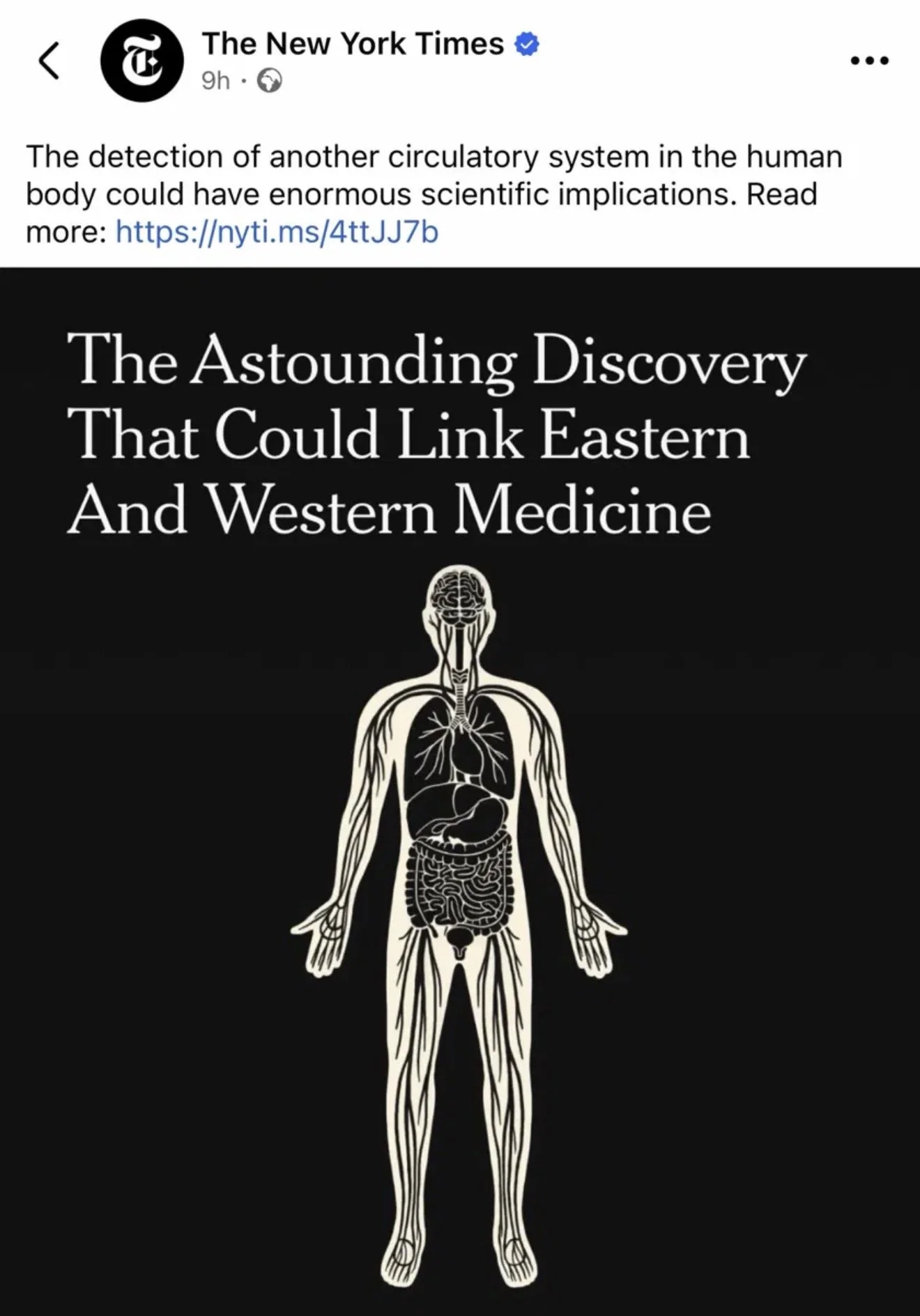
The New York Times ran a splashy interactive piece last week announcing the discovery of a third circulatory system in the human body: a body-wide network of fluid-filled spaces woven through the connective tissue that wraps every organ, every vessel, every nerve. They are calling it the interstitium, and the article has been shared enthusiastically by people who find this astonishing.
It was also published in 2018, by the same newspaper, in its own health section.
The original paper, from researchers at Weill Cornell Medicine, appeared in ‘Nature: Scientific Reports’ in March 2018, generated 2,400 news articles, and accumulated nearly 3.8 billion online views. The paper of record covered it straight the first time: here is a previously uncharacterised anatomical structure, here are the scientific implications, remarkable. Eight years later, the same newspaper has republished the same story in the magazine, this time with an acupuncture angle attached. The science got older. The woo got added.
The discovery itself is genuinely interesting. We have been dissecting human bodies since Herophilos of Alexandria in the third century before the common era, building increasingly refined maps of the body’s interior geography over two thousand three hundred years of anatomy, and we missed this. The reason turns out to be almost poetic: the standard histological technique requires slicing tissue very thin and drying it out, and when you dry out the interstitium, the fluid drains away and the connective tissue collapses flat, the method concealing the very thing it was designed to reveal. A team noticed something anomalous in a bile duct scan in 2015 and spent three years working out what they were looking at. The interstitium may explain how cancer spreads after metastasis, why inflammation travels so reliably across the body, and how certain drugs might reach tissues they currently cannot. Serious questions, seriously investigated.
‘Carefully’ is not the word for what the NYT did with it.
I have watched this pattern enough times to write the script in advance. A genuine scientific discovery is made, and before the follow-up studies have even begun, a flotilla of acupuncturists, homeopaths, energy healers, and chakra enthusiasts has seized the finding and declared it proof of everything they already believed. With quantum mechanics, this produced quantum healing, quantum water, and quantum energy bracelets, none of which had any relationship to quantum mechanics beyond the borrowed word, which was all they needed: the aura of legitimate strangeness, of a science so counterintuitive that perhaps, if you did not press too hard on what exactly ‘quantum’ meant in the context of a bracelet or a bottle of water, it could be stretched to cover whatever you were already selling, and the argument that resulted ran like this: physics has shown that reality is stranger than we thought, therefore my crystal does something. The entire apparatus of scientific method, its controls, its demand for reproducibility, its patient correction of error, simply skipped, because the conclusion had already been reached before the investigation began.
It is a beautiful piece of rhetorical judo: use the credibility of science to undermine the method that produces it.
The interstitium is getting the same treatment. Traditional Chinese medicine has for two thousand years described meridians through which a vital energy called qi is said to flow, channels Western anatomy has examined and never located. Western medicine has now found a fluid network throughout the connective tissue of the entire body. Therefore, the argument rushes, Western medicine has found the meridians and everything your practitioner told you is confirmed by peer-reviewed science. The interstitium transports fluid, not qi; it has no directional flow corresponding to meridian maps and no documented response to needles. For many conditions, acupuncture performs no better than a sham procedure in which needles are inserted at random points by an attentive practitioner; where small effects do appear, they require no meridians and no third circulatory system to explain.
Which raises the harder question: is the serious press becoming less serious, and if so, why?
The economics are not complicated. The advertising model that funded quality journalism collapsed after 2008, replaced by an attention economy where the algorithm rewards emotional intensity over factual density. A piece linking a rediscovered circulatory system to the ancient wisdom of acupuncture attracts the wellness audience, the science audience, and the sceptics simultaneously: three readerships, one piece, one set of production costs. That is not an editorial decision. It is a traffic decision wearing an editorial decision’s clothing.
There is also what I would call epistemic softening: the line between ‘here is what happened’ and ‘here is an interesting perspective’ has been deliberately blurred, partly because perspective pieces cost less to produce and are harder to fact-check, and partly because audiences trained on social media for twenty years have grown comfortable receiving opinion as information. When institutional trust collapsed after 2016, and certainly after COVID, serious outlets responded partly by doubling down on rigour and partly by chasing the emotional register that was beating them on every platform. The second response won more often. If people share things that make them feel something, journalism needs to make people feel something. The interstitium piece makes you feel wonder. The acupuncture link makes you feel that perhaps conventional medicine has been arrogant all along. These are feelings. They are not information.
None of this is unique to the NYT. But the NYT matters more than most, because the NYT’s credibility is what gets spent here, and when the paper of record legitimises a contested claim, that legitimacy is very difficult to retract. No correction will come, because the problem is not factual: it is interpretive. The original piece gets three million shares. The caveat, if it ever arrives, gets lost.
The body keeps surprising us, and I mean that with genuine pleasure. Two thousand three hundred years of anatomy and we are still finding new rooms in the house. Science is not a completed map; it is an ongoing act of revision, and each revision brings the map closer to the territory. The pseudoscientist looks at that revision and sees an opening: if science keeps getting things wrong, perhaps my thing is right. That reads it exactly backwards. Science gets things wrong, discovers the error through the method, corrects itself, and gets closer. The correction is the method.
The interstitium was found by a researcher who noticed something anomalous in a fluorescence scan and spent three years working out what it meant. The NYT spent eight years finding a way to link it to acupuncture.
Only one of those is how you find something real.
