
The Voice in the Mirror
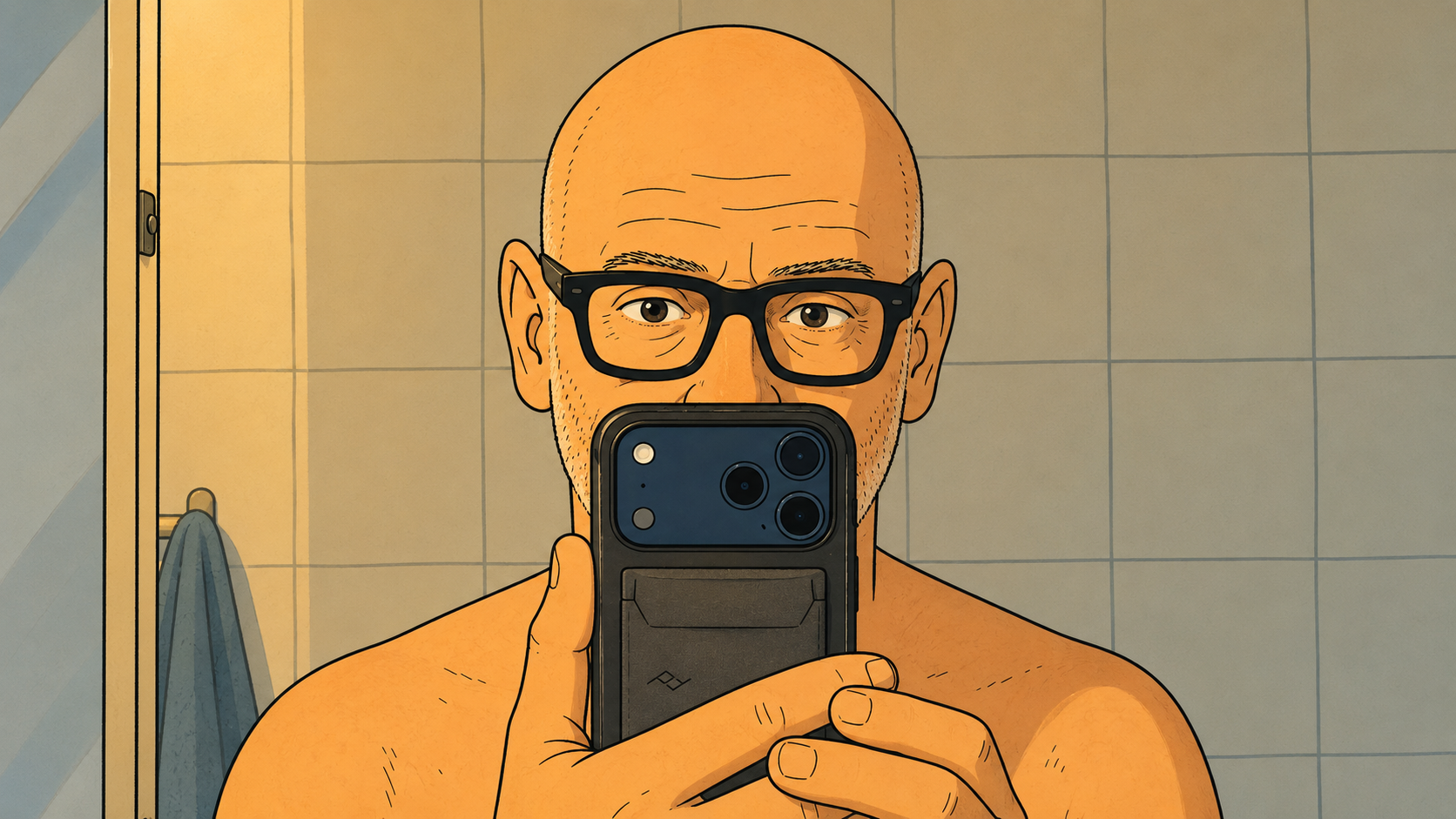
I am shaving, beard and head, watching my own face in the mirror, and I catch myself mid-thought in English. Not Dutch. Not Flemish. English. Perhaps I was not hearing thought itself, but only the part of thought that had dressed itself in sound. Something about that is surprising enough to stop me. Which raises the question: what exactly is happening in there?
The voice in my head is not a single thing. Researchers describe a spectrum, from what they call expanded inner speech, the deliberate, sentence-like kind I use to talk myself through a problem, to condensed inner speech, fast and fragmentary, barely registering as words at all. Most of the time, when I am writing in English, I am in expanded mode: conscious, structured, one word following another. But the thought I caught in the mirror was different. It was already there, fully formed, before I had really noticed it. That is the condensed kind, and what interests me is that it arrived in English rather than Dutch, because the two languages do not feel equivalent in my head. English came to me through books, the internet, television. It is more formal, more polished, a language I inhabit from the outside in. Dutch is the other thing entirely: richer, more emotionally complete, full of slang and texture and the particular weight that a mother tongue carries. So why was the quick, unguarded, barely conscious thought in English rather than Dutch? That is the question worth sitting with.
Among those who have taken that question seriously, Ray Jackendoff offers the most radical account. An American linguist and cognitive scientist who spent his career largely at Brandeis and Tufts, Jackendoff broke from the Chomskyan tradition in which he was trained to argue something genuinely unsettling: that thought itself is unconscious. Not partially, not mostly, but entirely. What surfaces into awareness is only the phonological stream, the sound of words, whether spoken aloud or heard internally. The talking voice in my head does not carry the concepts themselves; it provides a handle for gripping and manipulating what is already happening at a deeper level. The broadcast, not the newsroom.
Neuroscience broadly agrees, though it arrives there by a different route. The mind seems to work on several levels at once, some fast and instinctive, supplying intuitions, patterns, and emotional signals before we have found words for any of it, others slow and sequential, integrating and inspecting what the faster levels have already largely shaped. Think of walking into a room and immediately feeling something is wrong, only finding the words for what it is several seconds later. The feeling came first. Language was retrospective.
If thinking were simply inner speech, people without language would be denied any recognisable inner life. But artists, mathematicians, and musicians regularly report that their best thinking happens in a place where language is absent, where ideas arrive as patterns, images, or feelings, and words only come afterwards. Research by Linda Kreger Silverman suggests that roughly 30% of the population thinks primarily in visual and spatial terms, with another large group moving fluidly between visual and verbal modes. The inner monologue is one instrument in a larger orchestra, and for many people it is not even the lead.
The bilingual experience sharpens all of this considerably. The Sapir-Whorf hypothesis, in its strong form, holds that the language I speak determines the thoughts I can have. That version is largely rejected. The weaker claim, that language shapes and colours thought rather than imprisoning it, has plenty of evidence behind it, and for bilinguals it carries a personal truth that laboratory studies cannot fully capture. My English and my Dutch are not two vessels carrying the same water. English, built from reading and screens rather than from childhood and street corners, is a more formal instrument. It is the language in which I construct arguments, present ideas, think carefully in public. Dutch reaches places English does not. The emotional register is fuller. The slang is mine. When something genuinely moves me, or irritates me, or strikes me as absurd, the internal reaction tends to arrive in Dutch first. English is where I then choose to put it, if I am writing. So the fact that a fast, unguarded, condensed thought surfaced in English rather than Dutch suggests that something has shifted. Writing extensively in a language builds the inner machinery that allows it to carry thought automatically, below the level of deliberate composition. English has crossed a threshold. It can now operate in the quick, barely conscious register that sits closest to whatever is happening beneath language altogether. The thinking happens where it always did. What shifts is which language gets recruited to clothe it as it rises to the surface.
Thinking is not a word game, but word games are one of thinking’s instruments. The inner monologue is neither the whole of cognition nor a mere decoration. It sits at the interface between the vast unconscious machinery of the brain and the narrow bandwidth of conscious awareness. It is the part of thinking I can overhear.
The tondeuse moved on. The face in the mirror looked familiar. But somewhere behind it, beneath the words, something older and deeper had already done the thinking. The unsettling part is that I will never know what it was. My own mind is the one place I cannot go.
